


Mark Your Calendars for DSCC’s 2026 Family Education Webinar Series!
These free webinars will focus on SNAP benefits, estate and financial planning, and caregiver mental health
Our annual education webinar series returns in March with a whole new lineup of topics!
Join the Division of Specialized Care for Children (DSCC) and learn more about key programs and services for Illinois families and caregivers from the comfort of your home.
These free sessions will take place on the second Tuesday of each month and are open to anyone who is interested.
Presenters will cover a different topic each month and answer your questions. Each presentation will be in English. A Spanish interpretation line will be available during each session.
Check out the topics, mark your calendars and register for each session you’re interested in attending.
The session descriptions are in English followed by Spanish:
- Supplemental Nutrition Assistance Program (SNAP) Benefits, March 10, at 6 p.m.
- This webinar will explain how to apply for SNAP benefits. Presenters will cover who can get SNAP, how to apply and recent changes to the program.
- See the SNAP Benefits flyer
- Register for the SNAP Benefits Session on Zoom
- This webinar will explain how to apply for SNAP benefits. Presenters will cover who can get SNAP, how to apply and recent changes to the program.
- Estate and Financial Planning, April 14, at 6 p.m.
- This webinar will focus on estate and financial planning to preserve government benefits for a person with a disability. Presenters will discuss planning tools, protecting benefits and preparing for the future.
- See the Estate and Financial Planning flyer
- Register for Estate and Financial Planning Session on Zoom
- This webinar will focus on estate and financial planning to preserve government benefits for a person with a disability. Presenters will discuss planning tools, protecting benefits and preparing for the future.
- Caregiver Mental Health, May 12, at 6 p.m.
- May is Mental Health Awareness Month. This webinar will focus on mental health for caregivers. Presenters will talk about stress, burnout and ways caregivers can take care of their own well-being.
- See the Caregiver Mental Health flyer
- Register for the Caregiver Mental Health Session on Zoom
- May is Mental Health Awareness Month. This webinar will focus on mental health for caregivers. Presenters will talk about stress, burnout and ways caregivers can take care of their own well-being.
- Beneficios del Programa de Asistencia Nutricional Suplementaria (SNAP), 10 de marzo a las 6 p.m.
- Este seminario web explicará cómo solicitar los beneficios de SNAP. Los presentadores hablarán sobre quiénes pueden recibir SNAP, cómo presentar la solicitud y los cambios recientes en el programa.
- Consulte el folleto de Beneficios del Programa de Asistencia Nutricional Suplementaria (SNAP)
- Regístrese para Beneficios del Programa de Asistencia Nutricional Suplementaria (SNAP) en Zoom
- Este seminario web explicará cómo solicitar los beneficios de SNAP. Los presentadores hablarán sobre quiénes pueden recibir SNAP, cómo presentar la solicitud y los cambios recientes en el programa.
- Planificación Patrimonial y Financiera, 14 de abril a las 6 p.m.
- Este seminario web se enfoca en la planificación patrimonial y financiera para preservar los beneficios gubernamentales de una persona con discapacidad. Los presentadores hablarán sobre herramientas de planificación, cómo proteger los beneficios y cómo prepararse para el futuro.
- Consulte el folleto de Planificación Patrimonial y Financiera
- Regístrese para Planificación Patrimonial y Financiera en Zoom
- Este seminario web se enfoca en la planificación patrimonial y financiera para preservar los beneficios gubernamentales de una persona con discapacidad. Los presentadores hablarán sobre herramientas de planificación, cómo proteger los beneficios y cómo prepararse para el futuro.
- Salud Mental de los Cuidadores, 12 de mayo a las 6 p.m.
- Este seminario web se enfoca en la salud mental de los cuidadores. Los presentadores hablarán sobre el estrés, el agotamiento y las maneras en que los cuidadores pueden cuidar su propio bienestar.
- Consulte el folleto de Salud Mental de los Cuidadores
- Regístrese para Salud Mental de los Cuidadores en Zoom
You can also download a flyer with all the Family Education Webinar Series topics and registration links. (The flyer is also available in Spanish.)
Details about each series session are also posted on our Events page.
We began offering our free family webinars in response to questions and suggestions from our Family Advisory Council. The webinars are open to everyone.
If you miss a session, you can access the recordings and related materials on our Family Education Webinars page.
If you have questions about these webinars before or after a session, email dscc@uic.edu or call (800) 322-3722.
We hope you’ll join us!
Honor National Family Caregivers Month by Caring for Yourself
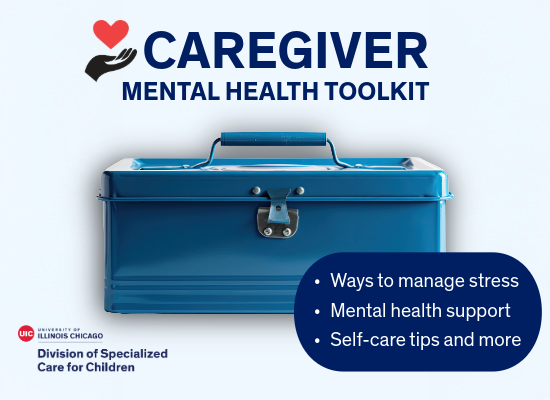
We’ve developed resources to help you support your mental health, reduce stress and connect with others who understand.
November is National Family Caregivers Month, a time to recognize and celebrate the incredible dedication of families caring for children and youth with special healthcare needs.
At the Division of Specialized Care for Children (DSCC), we know that caregiving can be both a rewarding and challenging journey.
As you care for others, it’s just as important to take care of your own mental health.
Find Support in Our Caregiver Mental Health Toolkit
Our Caregiver Mental Health Toolkit can help you find the support and strategies you need to recharge and stay well.
This online resource offers practical tips, self-care strategies and mental health resources to help you navigate the unique demands of caregiving while prioritizing your own health and well-being.
The Caregiver Mental Health Toolkit includes:
- Stress management strategies and techniques to help you cope with tough times.
- Self-care tips and practical ways to nurture your own physical, emotional and mental health.
- Mental health support resources to connect you with professional help and support networks when needed.
- Apps, online tools, videos and podcasts you can access anytime.
We created this toolkit with input from our Family Advisory Council, which shared the importance of mental health support for caregivers like you.
Whether you’re a parent caring for a child, a family member supporting a loved one or anyone in a caregiving role, we encourage you to explore this free resource.
Connect With a Fellow Caregiver for Support
One of the most powerful supports you can have is a connection with another parent who truly understands.
We have a Home Care Family Outreach Associate on our team who understands the unique challenges of caring for a loved one with complex medical conditions firsthand.
Our Home Care Family Outreach Associate works to create a community for caregivers within DSCC and offer heartfelt support, connection and empowerment.
You can ask your DSCC care coordination team to refer you to the HCFOA. You can also email a request to speak with the HCFOA at DSCC-FamilySupport@uic.edu.
Learn more about Erica Stearns, our current HCFOA, on our Home Care Family Outreach page and in the short video below:
Take a Break with Caregiver Coloring Sheets
We’ve also designed four coloring pages to help caregivers relax and take time to relieve stress and practice mindfulness.
There are four designs available in both English and Spanish:
- Lighthouse (Lighthouse in Spanish)
- Sunflowers (Sunflowers in Spanish)
- Hot air balloons (Hot air balloons in Spanish)
- Gears and clock (Gears and clock in Spanish)
These printable pages are a simple way to pause, relax and focus on yourself.
More Mental Health Resources and Support
You can find more mental health resources in our online Resource Directory.
Be sure to also follow our DSCC Facebook page and Instagram page for helpful reminders and tips throughout the rest of the month.
Your DSCC care coordination team is also here to support you. They can listen, help identify your needs and find available services and resources.
As the heart of your child’s care team, we celebrate you this month and always!
Project to Improve Mental Health Support Benefits DSCC Teens
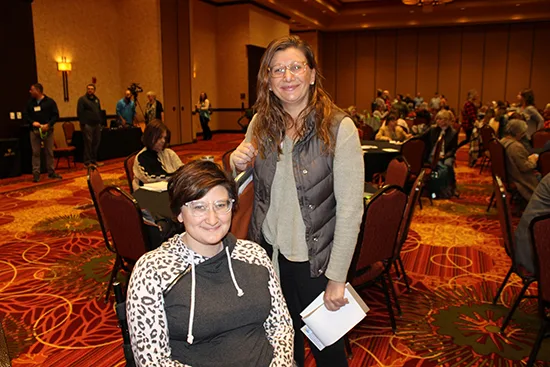
The B.E.S.T. study looks at how care coordination services that include mental health support can help teens with intellectual and developmental disabilities.
The teenage years can be a challenging time for all teens, including teens with intellectual and developmental disabilities (IDD).
Is your teen or young adult feeling sad, stressed or overwhelmed?
Consider joining the B.E.S.T. study. B.E.S.T. stands for Behavioral Health Stratified Treatment (B.E.S.T.) to Optimize Transition to Adulthood for Youth with IDD.
The B.E.S.T. study wants to know if care coordination services combined with mental health programming can help teens with IDD live happier and healthier lives.
All Division of Specialized Care for Children (DSCC) participants receive care coordination services. B.E.S.T. study participants receive access to additional behavioral and mental health resources and support.
DSCC participant Lily Kohtz, 19, (pictured on the left in the above photo) says her mental health has improved since taking part in the B.E.S.T. study.
Lily has spina bifida, uses a wheelchair and has difficulty with anxiety and depression due to her disabilities.
“I think a lot of people don’t connect anxiety or depression to having a disability,” she said. “The B.E.S.T. study has helped me talk about these things. We all have bad days, but depression is worse. Understanding how disability and mental health are tied together and having strategies to use to help me cope has really helped me.”
Lily says she’s enjoyed the online group sessions, where she now meets monthly with four other teens and a group leader. All meetings are confidential.
“We go over coping strategies such as controlling your thoughts and getting rid of the negative. I frequently use the skills we’ve learned and feel like my mental health has improved,” she said.
Lily’s mom, JoAnn Watkins (pictured on the right in the above photo), agrees that the study has benefitted Lily in many ways.
“I’ve seen a positive difference in Lily since she started with the B.E.S.T study. She’s using the skills she’s learned, and you can really see the improvement in her attitude and overall mental health.”
The study began recruiting participants in late 2022. More than 250 DSCC participant families have enrolled in the study so far.
Eligible DSCC participants must be enrolled in DSCC’s Core Program or Connect Care Program. (Please note that DSCC teens enrolled in the Home Care Program are not eligible to participate.)
The B.E.S.T. study is a free and voluntary project. Teens can join the study if:
- They currently have a DSCC Care Coordinator and are enrolled in DSCC’s Core or Connect Care programs.
- They are between 13 and 20 years old.
- They have an intellectual or developmental disability.
- They can comprehend at a fourth-grade or similar level.
- They can read and speak English.
- They have a computer, tablet or smartphone they can use to access the internet.
- They have permission from their parent, caregiver or guardian (if they are under 18).
The B.E.S.T. study team developed the project with input from a group of B.E.S.T. Study Scholars. These scholars are teenagers with IDD who tested and reviewed all of the B.E.S.T. study materials.
Teens who join the study are put into one of two groups:
- Group A receives care coordination services as usual from their DSCC Care Coordinator.
- Group B receives care coordination services and mental health support from the B.E.S.T. team. This support is based on each teen’s needs and can include:
- Mental health education
- Online group sessions
- Caregiver education and support
The study is a virtual program that will continue recruiting through December 2025.
The B.E.S.T. study is a partnership between DSCC and the University of Illinois Hospital and Health Sciences System (UI Health), the University of Illinois Chicago’s (UIC) Department of Disability and Human Development and the UIC Department of Pediatrics.
The principal investigators are Dr. Benjamin Van Voorhees and Dr. Kristin Berg.
The B.E.S.T. study team includes mental health professionals from Illinois, California and Massachusetts. They are all working together to find a way to promote the health and well-being of teens with IDD.
You can learn more information for both teens and parents/caregivers on the B.E.S.T. study website.
If you would like to join the study or have questions, please email the B.E.S.T. study team at beststudy@uic.edu or call (833) 732-5778.
If you choose to join, you and your family can support research that helps other teens and families.
Both parents/caregivers and teens must agree to be in the study. (Note that if a teen is their own legal guardian, they can participate alone or with a parent/caregiver if they choose.)
Those who join will be compensated for their time.
We’re excited to continue our partnership on this important research project!
New Nationwide Three-Digit Mental Health Crisis Number
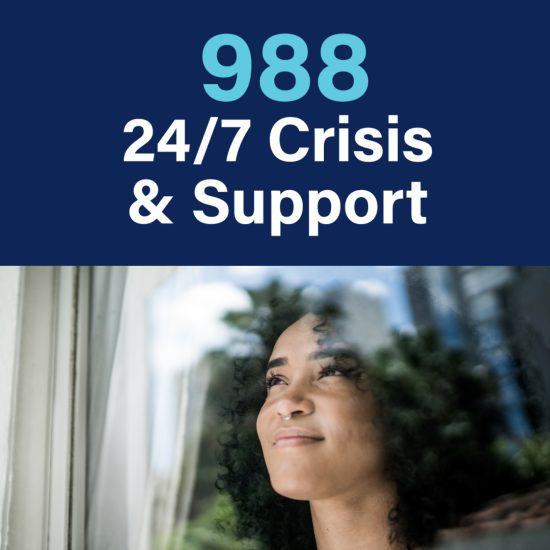
Individuals facing mental health crises can call 988 anytime for help and life-saving services
Starting on July 16, a simple three-digit number will connect anyone in the United States to the National Suicide Prevention Lifeline (also called the Lifeline).
The new 988 dialing code will help people facing mental health crises immediately connect to individuals who are specially trained to respond to such situations. It is available for calls (multiple languages) and text or chat (English only).
The Lifeline is free, confidential and available 24 hours a day, seven days a week.
Lifeline crisis counselors understand what callers are going through and know what local resources might make a difference. Anyone who needs support for a suicidal, mental health and/or substance use crisis may dial 988.
The new 988 number aims to strengthen efforts to transform crisis care nationwide. It will serve as a universal entry point so that no matter where someone lives, they can reach a trained crisis counselor who can help.
According to the Centers for Disease Control and Prevention, one in five Americans will have a mental illness in any given year.
The Substance Abuse and Mental Health Services Administration (SAMHSA) reports that in 2020 the United States had one death by suicide about every 11 minutes. Suicide is also a leading cause of death for people ages 10 to 34 years. Additionally, more than 100,000 individuals died from drug overdoses from April 2020 to 2021.
You can learn more about how 988 works and the support it provides on the 988 Frequently Asked Questions page.
This fact sheet also explains the basics about 988. (You can also see the fact sheet in Spanish.)
The current Lifeline phone number of (800) 273-8255 will remain available to people in emotional distress or suicidal crisis, even after 988 is launched.
Individuals may also continue to text the Crisis Text Line (text HOME to 741741). Both offer free, confidential help around the clock, 365 days a year.
You can also visit our online Resource Directory for more mental health services and support.
Resources and Tips to Promote Good Mental Health

Helpful tools and resources for individuals of all ages in honor of Mental Health Awareness Month
May is Mental Health Awareness Month.
Society often focuses on physical health rather than mental health, but both are equally important. Mental health plays a big role in our overall well-being.
Although the pandemic’s challenges have led to more conversations about mental health, talking about it can still feel difficult or out of reach.
It’s important to remember that we all face challenges in life that can affect our mental well-being.
Understanding the topic can help us maintain good mental health and be more informed when experiencing a mental health condition or crisis.
Our Division of Specialized Care for Children (DSCC) team has pulled together a few resources to help get started:
- Life can be challenging, but every day shouldn’t feel hard or out of our control. A mental health screening at mhascreening.org can help provide a quick snapshot of our personal mental health. The screening is free and anonymous. The screening results can help start a conversation with your primary care provider.
- Our DSCC Transition Tools include a Mental Health Resources tip sheet with a helpful list of crisis hotlines, service locators, videos and more.
- Mental Health America’s (MHA) Back to Basics Toolkit, available in English and Spanish, covers a wide variety of topics and tools including stress management, coping skills, recognizing when help is needed and where to find help and support.
- The National Alliance on Mental Illness (NAMI) has resources geared toward kids, teens and young adults. NAMI also provides a coloring and activity book and step-by-step guidance to help parents explore and talk to children about emotional topics or mental health challenges.
- The Illinois Department of Public Health (IDPH) has developed a new “Youth, Adolescent and Young Adult Suicide Prevention” webpage. It aims to help family members and others prevent suicide by knowing the facts about suicide, who is at risk, warning signs specific to this age group and protective factors.
- The Caregiver Action Network provides a Blueprint for Families of Loved Ones with Mental Health Issues.
Remember the National Suicide Prevention Lifeline at (800) 273-8255 and the Crisis Text Line (text HOME to 741741) are available 24 hours a day, seven days a week.
A new, nationwide three-digit number will also be available this summer for people facing mental health crises. Starting on July 16, anyone in the United States can call 988 and get connected to the National Suicide Prevention Lifeline.
More mental health resources are available in our online Resource Directory. You can also follow our DSCC Facebook page for more reminders and tips throughout the rest of the month.
Knowing the basics about mental health will help us all feel better prepared when needed. Support is out there, and recovery is possible.