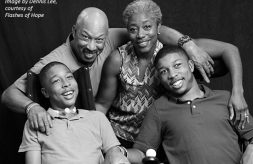
The Chapman Family

“We’ve been quite fortunate, blessed I would say, to have phenomenal Care Coordinators through DSCC, and I don’t take that for granted at all. They have a wealth of information. I’ve learned so much through my interactions with DSCC.”
— Dena Chapman, mom of Malachi
Dena Chapman believes deeply in the power of the parent voice, especially for parents navigating complex medical needs.
“The best resource for a parent of a child with medical complexities is another parent of a child with medical complexities,” she said.
Dena’s learned this lesson and continues to practice it, both as a parent and longtime family advocate.
Through her family’s partnership with the Division of Specialized Care for Children (DSCC), Dena has found connection, shared her hard-earned knowledge and built a network of support for her caregiving journey.

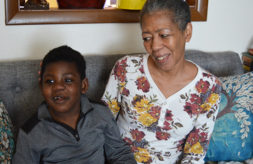
Dena Chapman and her son Malachi.
“DSCC has been a steady force in our lives and a great resource for my family,” Dena said.
Dena also serves on DSCC’s Family Advisory Council (FAC), where she strives to help uplift other families and learn from other caregivers.
“What’s great about the FAC is the wealth of knowledge that exists within this group—it’s invaluable! Our lived experiences deem each one of us experts in knowing the needs of our kids/young adults; our collective experiences serve as a resource for new families and seasoned families as well—I’m constantly learning new information that helps me to make informed decisions for my son, and I know everyone else in the group feels the same way,” Dena said.
“The FAC is a phenomenal community of resourceful family advocates and I’m very proud to be a part of it.”
A long, challenging journey

Malachi Chapman is unable to breathe on his own and uses a ventilator.
Dena’s son, Malachi, 26, has spinal muscular atrophy type 1. The condition affects his gross motor function, preventing him from walking, talking and breathing independently.
“I was not at all aware that I was going to have a child with disabilities, much less multiple disabilities and the severity or the complexity of it,” Dena recalled of Malachi’s diagnosis as an infant. “So that journey was very long and challenging and difficult because I didn’t know anyone, any other parents or families, that had a child with a disability. Everything changed in a blink of an eye. I had to learn all of Malachi’s intricate, complex care and it was very scary!”
As Malachi grew beyond his original life expectancy of two years, the learning and adapting never stopped.
Malachi is fully dependent upon his family and caregivers for his daily care. He uses a DynaVox augmentative communication device and also communicates with his eyes.
“The disease does not impact him cognitively, so he is alert, aware, engaged,” Dena said.
“In his environment, he has a lot of control, which I think is great, and always making sure that the nurses and caregivers allow him to have as much control of his environment as possible.”
“Phenomenal Care Coordinators” and a wealth of information
Dena learned about DSCC when Malachi was just over a year old and she was working in Early Intervention as a Parent Liaison.
“We’ve been quite fortunate, blessed I would say, to have phenomenal Care Coordinators through DSCC, and I don’t take that for granted at all,” Dena said. “They have a wealth of information. I’ve learned so much through my interactions with DSCC.”
This support has been crucial as Malachi transitioned from pediatric to adult providers, exposing the family to a whole new system and set of challenges. Dena says it was difficult to shift from Malachi’s familiar and supportive pediatric care teams and rebuild provider relationships.
The adult healthcare system has required greater self-reliance and confidence, leading Dena to feel moments of self-doubt even after years of caregiving.
These obstacles reinforced Dena’s belief in the power of parents’ voices and that no one should do it alone.
Find your people and pay it forward
Over the years, Dena became involved in efforts to elevate family voices and strengthen family engagement.

Malachi smiles with his brother, Josh.
She has served as a Parent Liaison in Early Intervention, a master trainer in parent engagement and parent leadership development and been a key voice in the development of a new Early Childhood Education and Care system for Illinois.
Dena also connected with other parents of children and young adults on the Medicaid Home and Community-Based Services Waiver for Those Who are Medically Fragile and Technology Dependent.
She met fellow DSCC parent and FAC Co-Chair Erica Stearns, who encouraged her to check out the council.
“She talked a lot about wanting to utilize my skills and my story, especially around the adult transition,” Dena said. “There’s a lot of work to be done there, and I really wanted to dig into that, and so that really helped me to get more involved with the FAC and then an opening came up, so it was a godsend.”
Dena described the FAC as a welcoming, knowledgeable and supportive group where parents share resources and expertise. She enjoys continuing to learn from other families’ perspectives and sharing the lessons she’s learned during her 26 years of caregiving.
“We have to step up in our knowledge base so that we can provide the best care for our families and also to pay it forward for the families that are coming behind us,” she said.
Through the FAC, Dena is helping develop a Caregiver Toolkit that provides practical tips, resources and “a blueprint” for what parents can expect after a diagnosis.
Dena also partnered with DSCC’s Transition Specialist to train DSCC staff on family partnerships in transition planning. Dena said she wants to highlight the diversity of transition experiences and that goal setting and independence often look different for young adults with complex medical needs.
Dena encourages all parents to take advantage of the FAC’s open forums, which occur twice a year.
“You can’t go wrong being a part of this group,” she said. “You’re going to learn, you’re going to grow, and you’re going to feel like you are contributing in a way that is both meaningful and impactful.”
Above all, Dena encourages parents to “find your people.”
“Those friendships are so critical because parents often feel like we’re alone in this, and we’re the only one going through it, but that’s the farthest from the truth,” she said. “There are other people out there, and you’ve just got to find your people.”
Find out more about Dena’s background and her fellow FAC members on our Meet Our Family Advisory Council Members page.
To learn more about how DSCC can help facilitate parent connections, visit our Parent-to-Parent Support page.