


New Monthly Mama Therapy Group for Central Illinois Caregivers
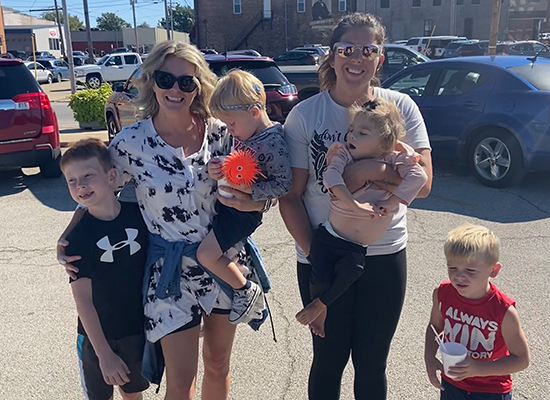
A DSCC mom and her friend started the Facebook group to connect with other parents of children with special needs
Thanks to an outing at a coffee shop, hearing aids and an impromptu conversation, two moms with children of similar ages and needs connected.
“I saw her daughter’s hearing aids. My son has them, too, so I just started talking to her,” Lace Mandrell said of her first meeting with Bailey McBurney Imig.
In no time Lace and Bailey were texting, talking and sharing tips, concerns and road trips to specialists.
Their immediate connection led to a new Facebook group called “Monthly Mama Therapy.”
Monthly Mama Therapy aims to help central Illinois caregivers of children with special needs connect with and support one another.
“If you’re trying to understand a diagnosis or therapy, running from appointment to appointment or saving for the next piece of equipment, things can be challenging,” said Lace “We just thought that having a network of moms with a wide range of experiences, ready to back you up on the good days and the bad days, would be amazing.”
Lace is the mother of two sons, Ollie and Auggie. Auggie, 3, is bilaterally deaf and has had cochlear implant surgery. He also has Chiari Malformation and was diagnosed with Waardenburg Syndrome.
“He’s a wild child who rarely stops moving,” Lace said. “He’s sweet, inquisitive and a little sponge excited about learning and soaking up everything around him.”
Auggie is a participant in the University of Illinois Chicago’s Division of Specialized Care for Children (DSCC). He has been enrolled with DSCC since 2019.
Bailey McBurney Imig is also the mother of two: Paxton, 3, and Parker, 2 1/2. Parker is deaf and has undergone multiple screenings and tests. There is still no diagnosis for her other conditions.
“With all of the testing and so few answers, I feel like she’s probably that one in a million child who will have a diagnosis named after her,” Bailey said. “But, despite all her complications, Parker is a tiny, little bundle of joy who loves attention. She’s an easy-going cuddler who is almost always happy and smiling.”
During their first meeting, Lace and Bailey related to each other right away.
“We just hit it off and I’m so glad. With HIPAA (the Health Insurance Portability and Accountability Act) and concerns for privacy, it can make it hard to connect. Then COVID-19, online therapies and everything else got thrown in,” said Lace. “It’s hard to do this stuff alone. It can get really complicated and overwhelming.”
The more Bailey and Lace talked, the more they wanted other moms in the “same or similar boat” to have a safe space where their kids could connect and they could relax, share and recharge. The seed for Monthly Mama Therapy was planted.
Monthly Mama Therapy has a private Facebook page and hosts meet-ups at local parks, coffee shops and other venues in the Champaign and Bloomington areas. Conversations online and in-person may range from accessible parks and walking trails to experiences with therapies or the transition to school.
The group promotes “therapy” and the importance of caregivers taking care of their own needs, too.
“The online community is really growing. When someone asks a question, the support and responses have been great,” said Bailey. “Our ultimate goal is to build an in-person community that’s just as strong.”
Monthly Mama Therapy hopes to continue growing online and meeting in person when the weather turns cool at central Illinois locations where distancing is possible.
“Our wish list includes adding some veteran parents who are willing the help the ‘newbies’ navigate and prepare for the transitions ahead,” said Lace. “We’d also love to add activities like exercise or yoga to do together.”
For more information, visit the Monthly Mama Therapy Facebook page.
Resources for LGBTQ+ Youth With Disabilities and Their Families

DSCC aims to help families strengthen their support to promote young people’s health, safety and wellbeing.
The University of Illinois Chicago’s Division of Specialized Care for Children (DSCC) wants to help Illinois families strengthen their support for LGBTQ+ youth with special healthcare needs and disabilities.
June is Lesbian, Gay, Bisexual, Transgender and Queer (LGBTQ+) Pride Month. There are approximately 5 million LGBTQ+ individuals with disabilities in the United States, according to the nonprofit RespectAbility.
Our DSCC team can provide resources to help our participant families, healthcare providers and community partners understand and support LGBTQ+ youth and their needs.
Research shows that family involvement in an LGBTQ+ youth’s life, particularly in the first two years of coming out, improves their overall safety, health and long-term well-being.
Teaching children about self-awareness and self-care at a young age can lead to better health and safety as a teenager. Helping a child establish boundaries is also linked to better teen health and safety.
Former DSCC Quality Specialist Diane Becker has studied research in these areas. Diane is a nationally certified juvenile treatment specialist and a licensed clinical social worker. She has worked with families and professionals in the social work and counseling fields for 30-plus years.
Diane appeared on the “Just Breathe: Parenting Your LGBTQ Teen” podcast last year to talk about mental health, boundaries and self-care for both LGBTQ+ young adults and parents.
She shared the latest research and discussed the importance of connectedness, family and health and safety.
You can listen to Diane’s two-part interview at the links below –
- What Are These Boundaries You Speak Of? An Interview with Diane Becker Part One
- What Are These Boundaries You Speak Of? An Interview with Diane Becker Part Two
We also encourage Illinois families of LGBTQ+ youth with special healthcare needs to contact us with their questions and concerns. You can call us at (800) 322-3722 or email us at dscc@uic.edu to learn more about available resources and support.
You can also visit our online Resource Directory.
Featured resources that can help support LGBTQ+ youth and their family/caregivers include:
National and Statewide Crisis Hotlines
- Find a Helpline
- National Suicide Prevention Lifeline
- National Domestic Violence Hotline
- The Substance Abuse and Mental Health Services Administration’s (SAMHSA) National Helpline
- Illinois Crisis and Referral Entry Services (CARES) Line
- Illinois Warm Line
- National Runaway Safeline
Connections
- The Trevor Project
- Central Illinois LGBTQ+ Organizations
- Chicago and Illinois Mental Health Agencies and Organizations
- Strong Family Alliance
- PFLAG Parent Support and Resources
- “Expressing, Coping, Reframing: Addressing the Mental Health of ‘Quaranteens’ in the Time of COVID-19”
- It Gets Better Project
Find a Healthcare Provider
- University of Illinois Hospital & Clinics’ Inclusive Healthcare and Policies
- Gender Development Program at Ann & Robert H. Lurie Children’s Hospital of Chicago
- GLMA
- OutCare Provider Directory
Education
- Illinois State Board of Education LGBTQ Student and Family Resources
- Advocating for LGBTQ Students With Disabilities
- Know Your Rights: Students and LGBTQ Rights at School
Information
Podcast Highlights DSCC “Resource Hunter”

Mom’s new podcast features Care Coordinator Amanda Kaufman and how she helps children with medical complexity through DSCC
As a Care Coordinator in the Home Care Program, Amanda Kaufman guides parents and caregivers as they learn to care for their medically complex children at home.
One of those parents formerly on her caseload is Erica Stearns. Erica is the mother of two Home Care participants, 5-year-old Margot and 3-year-old Caratacus.
Earlier this year, Erica started a podcast called, “Atypical Truth.” The podcast focuses on issues affecting caregivers, individuals with disabilities and individuals with complex medical conditions.
Erica recently invited Amanda on the podcast to talk about her role at the Division of Specialized Care for Children (DSCC), where she works in our St. Clair Regional Office.
During the conversation, Erica spoke about how Amanda and DSCC have provided invaluable support to her family:
“DSCC was one of the first organizations to step into our lives. They were some of the first social workers who came into our home and really began helping us to navigate our new lives with a medically complex child.
The beginning of this experience was actually very difficult. It occurred during a time when I was still learning how to cope with the acceptance of the unexpected that came with this unknown diagnosis.
DSCC has played a tremendous role in helping our family to thrive, really. Not only have they helped to provide the means for us to care for our children at home rather than in a hospital or an institution, they’ve also supported us emotionally throughout every step of this journey.
They are the people who we can guarantee to check in on us regularly, to tell us about a resource or a charity that might benefit our children, and they even go so far as to send birthday cards to each of the kids, which I just can’t express it enough how touching and heartwarming that singular gesture is.”
Amanda talked about her background as a social worker and her passion for connecting families to the right resources.
“I love finding resources, and I love being successful at finding something that a family needs,” Amanda told Erica.
Amanda also shared how caring for her late mother now helps her relate to her participant families’ challenges and emotions.
You can access the entire podcast episode, titled “Resource Hunter,” on the Atypical Truth website. It is available for listening on all popular podcast streaming services.
A big thank you to Erica for featuring DSCC and highlighting Amanda’s compassion and commitment to our participant families!
Free Tax Preparation Help for Illinois Families

Programs provide help for persons with disabilities, limited English-speaking taxpayers, low-income families and individuals over 60
Free tax help is available for Illinois residents in need through several programs across the state.
The Internal Revenue Service (IRS) and AARP Tax-Aide programs are offering free basic income tax return preparation with electronic filing to qualified individuals in select locations statewide.
The availability of services will vary by region.
“Taxes are due on April 15 this year. If a qualified taxpayer needs help filling out their return, free assistance is available,” David Harris, Director of the Illinois Department of Revenue, said in a news release.
“While in-person assistance is more limited due to the COVID pandemic, certified volunteers are still available to help people over the age of 50 years and working-class taxpayers file their state and federal returns accurately and on time while ensuring the health and safety of taxpayers and volunteers.”
*Note the Internal Revenue Service announced it has extended tax deadlines until May 17.
The IRS Volunteer Income Tax Assistance and the Tax Counseling for the Elderly programs offer free tax help for individuals who:
- Make $57,000 or less
- Have a disability
- Speak limited English
- Are 60 years of age or older
Taxpayers can search for a free tax assistance provider closest to them by visiting the Illinois Department of Revenue’s website at tax.illinois.gov.
The IRS-sponsored Ladder Up Virtual Tax Assistance Program also provides free basic tax return preparation for low-to-moderate-income and elderly taxpayers.
The AARP Foundation Tax-Aide program provides free tax assistance to taxpayers over the age of 50 or who have low-to-moderate income. Availability is determined at the local or community level by appointment only (walk-in service is unavailable this year).
Decisions on whether a site offers an all-virtual, light contact or in-person approach will be based on safety and health data from Johns Hopkins about COVID-19 levels in a community.
The site locator will be regularly updated, and short-notice changes are possible. AARP membership is not required to receive assistance.
See the state’s Free Tax Preparation news release for more information on all available tax help services.