COVID-19 Memory Book Activity for Families
DSCC provides memory booklet for children and families to complete together during the pandemic.
From school closings to parents suddenly working from home, the coronavirus (COVID-19) pandemic has drastically changed Illinois families’ way of life over the last two months.
To help children express themselves and record their experiences during the Stay at Home Order, we’ve created our own COVID-19 Memory Book that families can print out and complete.
The book includes an “About Me” section for children and youth to fill out as well as their favorite ways to stay busy, what they are thankful for, how they’ve stayed connected with others and a list of celebrations that happened during social distancing. There’s also a page for children to fill out if they celebrated a birthday during the pandemic.
The back page includes information about the COVID-19 resources compiled by the Univesity of Illinois at Chicago’s Division of Specialized Care for Children (DSCC). The resources include links to more at-home learning opportunities and activity resources for families.
Click on the COVID-19 Memory Book link to print the PDF.
The book is also available in Spanish.
DSCC Family Brings Apraxia Awareness to Central Illinois
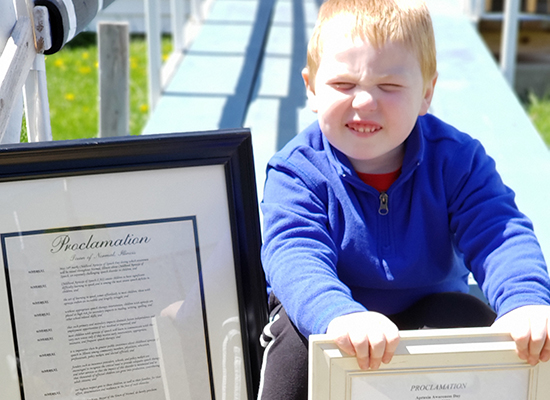
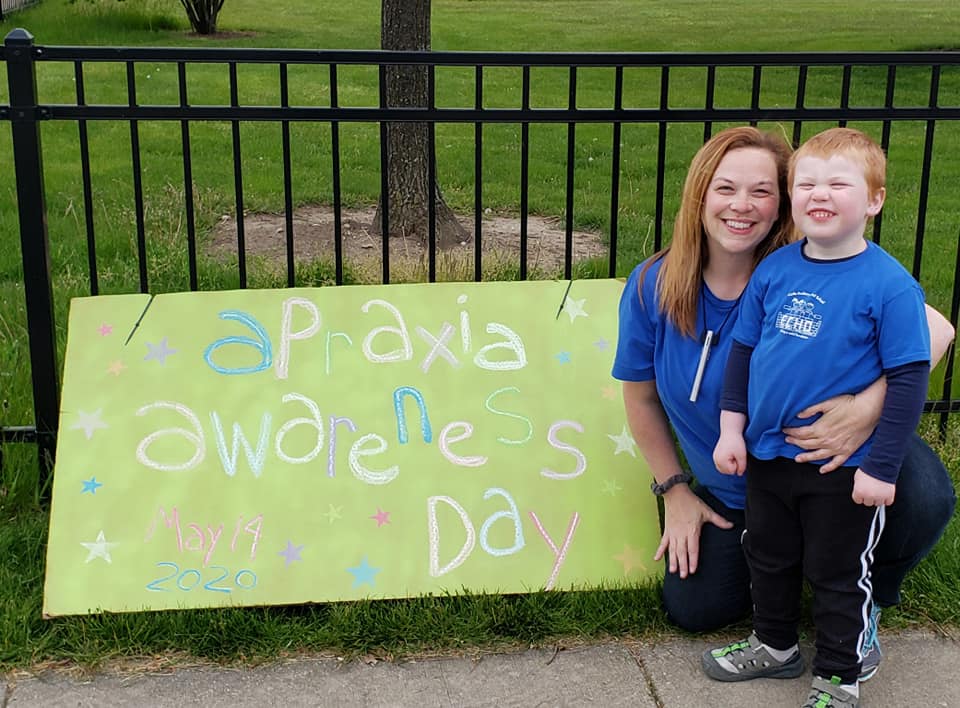
Mandy Nicolaides is raising awareness about her son’s severe speech and communication disorder.
Mandy Nicolaides thought her son may never speak.
At 3 years old, he could say less than five intelligible words, she recalled.
Eldon knew what he wanted to say. The message from his brain wasn’t connecting with his mouth muscles to make the right sounds.
Eldon was diagnosed with childhood apraxia of speech. It’s a
motor speech disorder that makes it difficult for a child to plan the right
mouth movements for speech.
With the right speech therapy, Eldon has flourished and is
now able to speak full sentences at 4 years old.
Apraxia is one of the most severe childhood speech and communication disorders. Yet, it is often misunderstood or unfamiliar to the general public. Mandy is now working to raise awareness and share Eldon’s story.
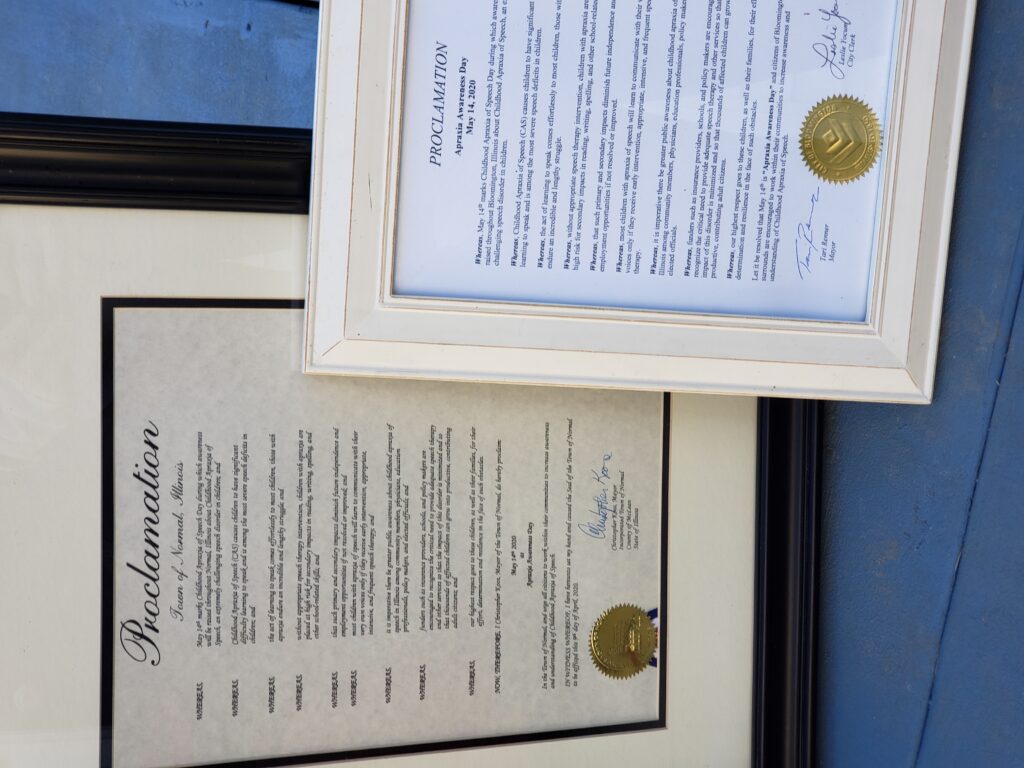
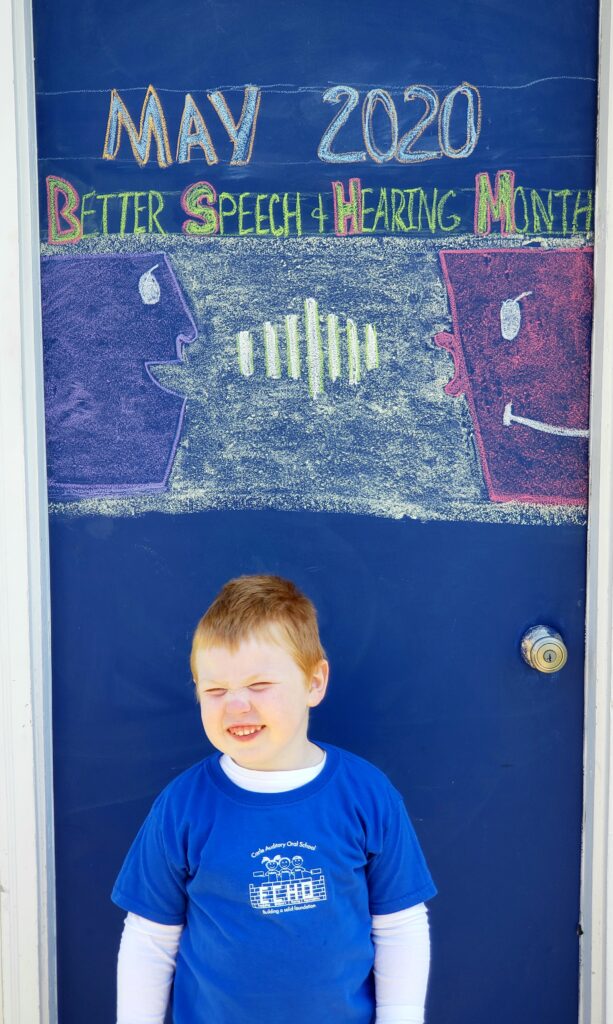
Mandy petitioned the city councils in Bloomington and Normal to declare May 14 Apraxia Awareness Day in their communities. McLean County will also make a proclamation for Apraxia Awareness Month in May. May is also Better Hearing and Speech Month.
Mandy believes it’s important to be a strong advocate for
her child and educate the community about Eldon’s condition.
“It’s frustrating because a lot of people look at him and
think he doesn’t know what he’s saying,” she said. “His receptive language is
insane. His speech just sometimes comes out as gibberish, but he thinks he’s
saying it perfectly clear.”
Eldon was born with severe hearing loss in his right ear and
now has a cochlear implant.
He began receiving Early Intervention services shortly after
birth. He later enrolled with the University of Illinois at Chicago’s Division
of Specialized Care for Children (DSCC).
As he grew, Eldon struggled to speak. Mandy at first thought he had a developmental delay.
One of his Early Intervention therapists diagnosed him with
childhood apraxia of speech around his 3rd birthday.
Mandy then enrolled Eldon in the Carle Auditory Oral School
(CAOS) in Urbana. The program helps children with and without hearing loss
develop spoken language and listening, thinking and learning skills.
At CAOS, Eldon receives extensive speech therapy with speech
pathologists well-versed in apraxia, Mandy said.
Since the family lives in Bloomington, Mandy drives an hour each way to take Eldon to school. She says the commute is well worth it.
“It’s amazing. I cannot say enough good things about what this school does for these kids. If they were not there, I know without a doubt Eldon would not be where he is,” she said “Every child with apraxia is different. They might struggle with different sounds or words, so his school is tailored to each child and their needs.”
Speech therapy is vital for youth with childhood apraxia of
speech.
“The biggest thing is being able to diagnosis it properly.
Kids can be so different on what they struggle with,” Mandy said. “With Eldon,
it’s a double-whammy. He has the apraxia and he has the hearing loss, which
makes it difficult to pinpoint sounds.”
Mandy is thankful for the support from the CAOS program,
Early Intervention and DSCC to help Eldon receive the right therapy and
services for his unique needs.
“Early intervention gave me so much insight and answers to
so many questions and helped guide me in the right way,” she said.
Mandy calls her DSCC Care Coordinator, who is a
speech-language pathologist, phenomenal. She attends Eldon’s appointment
and takes notes for Mandy. She also helps the family find resources and stay on
track with important deadlines.
“It’s definitely been an emotional journey and an exciting
and scary journey,” Mandy. “I remember people telling me at the beginning of
this to document everything… It’s hard sometimes when there isn’t a lot of
progress or times when we’re stagnant. But then I look back and remember where
he was and that all of these little accomplishments are huge for him.”
For more information on apraxia, visit www.apraxia-kids.org.
More information on Eldon’s progress and the family’s fundraising efforts for the Carle Auditory Oral School is available on their fundraising page.
DSCC Phone Number Reminder for Participants
DSCC’s posted office phone numbers are best way to reach our staff by phone.
Our staff is here to help Illinois families navigate the far-reaching effects of the coronavirus (COVID-19) pandemic.
We want to make sure Division of Specialized Care for Children (DSCC) participants use the correct phone number when calling their Care Coordinator or other DSCC team member.
Participants and community partners should use the local number or toll-free 800-number for each regional office posted at https://dscc.uic.edu/find-an-office/.
Our office numbers are also listed on our brochure and in our Family Handbook for participants.
You may also call our general toll-free number at (800) 322-3722 and we’ll direct you to the right place.
We have updated our phone system. Our main office numbers remain unchanged, but previous internal phone numbers will be disconnected.
Please only use our listed office phone numbers going forward.
Thank you for your cooperation!
2020 Parent Institute Canceled
The Institute for Parents of Preschool Children Who are Deaf or Hard of Hearing is canceled due to the COVID-19 pandemic.
We are sorry to announce that this year’s Institute for Parents of Preschool Children Who are Deaf or Hard of Hearing is canceled.
This decision follows the Governor’s executive orders to keep schools closed, keep people home, maintain social distancing and promote public health during the coronavirus (COVID-19) pandemic.
The Institute is a one-week program for parents of children ages 5 and under who have a significant hearing loss. It takes place on the campus of the Illinois School for the Deaf in Jacksonville each June.
Participating parents attend daily lectures by experts in the field to learn about raising a child with hearing loss.
Although we cannot gather in person, parents can still access presentations from the Institute’s experts.
As a supporter of the Institute, the University of Illinois at Chicago’s Division of Specialized Care for Children (DSCC) has made these presentations available online so they can benefit more families of children with hearing loss.
Videos on each topic are posted on the Illinois Sound Beginnings website.
Parents and caregivers can watch each presentation at their own pace in the comfort of their own home.
We will announce details for next year’s Institute after organizers determine a date.
If you would like more information about the Institute, call us at (800) 322-3722 or email Institute@exchange.dscc.uic.edu.
DSCC Family Spreads Easter Joy to Hospitalized Children
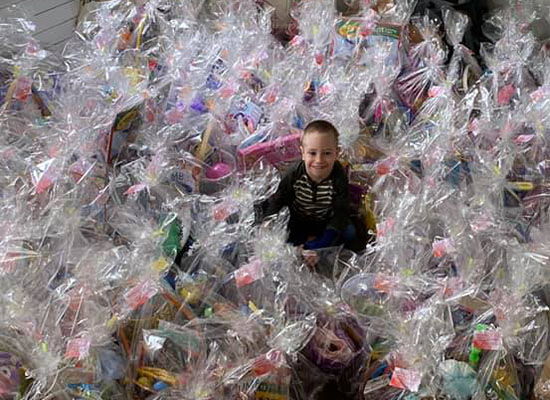
The Johnson family donated 160 Easter baskets for children at Central DuPage Hospital, surpassing their goal despite the coronavirus outbreak
Andrea Stambaugh vividly recalls the disappointment she felt
when her son, Axel Johnson, was in the pediatric intensive care unit on Easter
weekend 2018.
There would be no coloring eggs, Easter egg hunts, or other
favorite family celebrations.
“I was feeling like a failure because I didn’t have an Easter basket beautifully wrapped and thoughtfully hidden here for Axel to see on Easter morning,” Andrea wrote on her Facebook page, “Axel’s Journey with CMV.” “Then, as the lights turned down in the hallway and it grew quiet, I heard a family in the hallway praying. Praying not for Easter baskets and a chance to color eggs, but for life.”
The moment immediately changed her perspective. Andrea vowed to offer love and support to such families who can’t be home making memories with their children.

For the last two years, the Johnsons have collected donations to fill Easter baskets for hospitalized children. Despite unexpected challenges from the coronavirus outbreak, the family surpassed this year’s goal and delivered 160 Easter baskets to Central DuPage Hospital in Winfield.
“We know the burden and the mom guilt that people feel when they can’t provide their kid a proper holiday. We know that that’s a lot of stress and a lot of burden and frankly, the families are dealing with a lot of other things if they’re in the hospital,” Andrea said. “They shouldn’t have to feel that pressure, so we’re here to make sure that’s relieved from them and that they can focus on healing for their child.”
Axel is 3 years old and a participant in the University of Illinois at Chicago’s Division of Specialized Care for Children program.
After his Easter hospitalization, Andrea researched information
from other organizations who coordinate Easter basket donations. She put
together a list of suggested items, including coloring books, puzzles, dolls
and action figures. She then asked her page followers for donations.
The Johnsons hoped to collect enough items for 25 baskets for Easter 2019. Donations far exceeded this goal. A team of volunteers helped them put together a total of 125 baskets for children at multiple Chicago-area hospitals.
This year, the Johnsons aimed to donate 150 baskets. They
set up an Amazon wish list for Easter basket items, and donations started to
pour in. But challenges soon arose as the coronavirus outbreak escalated. For
safety reasons, two hospitals could no longer accept donations for patients.
Central DuPage Hospital could accept the baskets if the
Johnsons followed strict safety precautions.
“We have an immunocompromised child, so we know about the
importance of keeping the children and the families safe during this time,”
Andrea said.
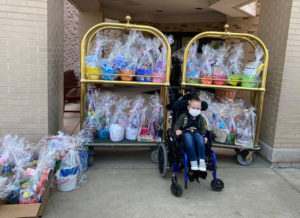
Every Easter basket item was purchased new and cleaned with bleach spray or a sanitizing wipe. Andrea and her partner, Adam Johnson, wore gloves and masks while sorting the items and wrapping the baskets with cellophane and personalized notes.
Due to the pandemic’s social distancing requirements, Andrea
and Adam spent 16 hours packaging 160 baskets without their usual team of
volunteers.
Last weekend, they delivered the baskets to Central DuPage
Hospital in Winfield to be ready for patients on Easter Sunday.
“It makes our hearts really happy every year when we get to
see the finished product and all of the kids that will be blessed this Easter,”
Andrea said.
The family is also already planning to provide baskets to
more hospitals next Easter.
For more information about their project and Axel’s condition, visit “Axel’s Journey with CMV” on Facebook.
Home Medical Supply Guidance for Families During COVID-19 Outbreak
Instructions for safely cleaning and re-using supplies for technology-dependent children.
Adequate
medical supplies are essential for families caring for children who are
medically fragile and technology-dependent at home.
The
University of Illinois at Chicago’s Division of Specialized Care for Children
(DSCC) wants to make sure our participant families can keep their supplies
properly stocked through the coronavirus disease 2019 (COVID-19) outbreak.
We’ve compiled guidance and instructions to help families safely clean and re-use supplies in case there’s a future shortage. *Please note you should check with your child’s care team to make sure these guidelines are appropriate for your child.
The DSCC Guidance on Home Medical Supplies includes instructions for cleaning and re-using:
- Feeding supplies
- Suction supplies
- Tracheostomy supplies
- Ventilator equipment
- Nebulizer equipment
*Again, please check with your child’s care team to make sure these guidelines are appropriate for your child.
The guidance is available on our Home Care Information and Resources page as well as in our list of COVID-19 resources and supports for families.
Our
Care Coordinators are also available to discuss strategies and help you become prepared
and well-equipped for your child’s care in the weeks and months ahead.
Please
reach out to your local regional office or call us at (800)
322-3722.
Resources for Special Needs Families During COVID-19 Pandemic
Meals, financial help, health tips, condition-specific information, learning tools and more to support families of children with special healthcare needs.
Parents and caregivers have a lot to juggle as they care for a child with special healthcare needs amid the coronavirus disease 2019 (COVID-19) outbreak.
The uncertainty and required social distancing can pose unique challenges, questions and concerns.
The University of Illinois Chicago’s Division of Specialized Care for Children (DSCC)’s team of professionals is here to help.
We’ve compiled a list of resources to help families find the right support: https://dscc.uic.edu/browse-resources/covid-resources/.
The list includes places offering free meals, utility assistance, free Wi-Fi, health tips, educational websites, activities during social distancing and condition-specific information.
Resources are also broken down by our regional office locations.
We’ll continue to update this list as new resources become available. Please check back often for the latest information.
If you have a resource to add to our list, please email us at dscc@uic.edu.
Tips for Medical Supply Preparations During COVID-19 Outbreak
We’re here to help participants and their families plan and take the proper precautions with their medical supplies during the COVID-19 outbreak.
Many families enrolled
with the University of Illinois at Chicago’s Division of Specialized Care for
Children (DSCC) rely on medical supplies for their child’s care.
Now is a good time
to plan for how to keep your supplies properly stocked through the current coronavirus
disease 2019 (COVID-19) outbreak.
We suggest you reach
out to your child’s medical provider about how to safely reuse and/or make
supplies last longer. This information can help you act in the best interest of
your child in case there’s a need to conserve medical supplies in the future.
We also recommend
asking your provider about getting extra necessary medications to have on hand
or using a mail-order option.
Your DSCC Care
Coordinator is also available to discuss strategies and help you feel prepared
and well-equipped for your child’s care in the weeks and months ahead.
Please reach out to your local regional office or call us at (800) 322-3722.
Important COVID-19 Update for DSCC Families
DSCC taking steps to protect our participants, their caregivers and our staff, including suspended home visits and limiting office visitors.
The University of Illinois at Chicago’s Division of Specialized Care for Children (DSCC) has an important update about the coronavirus disease 2019 (COVID-19) pandemic.
We want you to be aware of some precautions we are taking to protect our program participants, their families/caregivers and our DSCC team.
We are limiting visitors in our office until the guidance changes. We feel this step is necessary to protect the participants of our program and our staff.
If you arrive at one of our offices, you will be asked to call to tell us more about how we can help you.
We are also suspending home visits or other face-to-face visits until the current situation improves.
DSCC Regional Offices plan to remain open. If we have to close an office, we will still have staff available through our other DSCC locations who can help you get the care you need.
Since the guidance on ways to slow the spread of coronavirus is evolving, please watch our website for continued updates.
Our DSCC team remains committed to our mission to partner with Illinois families and communities to help children and youth with special healthcare needs connect to the services and resources they need.
We appreciate your patience and understanding as we all do our part to help slow the spread of the coronavirus.
Be well!
Parent Institute Lectures Available for Families of Children With Hearing Loss
Families can watch video presentations from experts in the field on a range of topics affecting children who are deaf or hard of hearing.
The Institute for Parents of Preschool Children Who Are Deaf or Hard of Hearing is a one-week program for parents of children ages 5 and under who have a significant hearing loss.
It takes place on the campus of the Illinois School for the Deaf in Jacksonville each June. Participating parents attend daily lectures by experts in the field to learn about raising a child with hearing loss.
Lecture topics include:
- Individuals With Disabilities Education Act (IDEA)
- Advocacy
- Communication Options
- Language
- Assistive Listening Devices
- Literacy
- Amplification
The University of Illinois at Chicago’s Division of Specialized Care for Children (DSCC), a supporter of the Institute, is making these presentations available online so they can benefit more families of children with hearing loss.
Videos on each topic are posted on the Illinois Sound Beginnings website.
Parents and caregivers can watch each presentation at their own pace in the comfort of their own home.
If you are interested in participating in the next Institute or would like more information, call us at (800) 322-3722 or email Institute@exchange.dscc.uic.edu.
You can also visit our Events page for more details about the 2020 Institute.
You may also read a recap of the 2019 Institute at https://dscc.uic.edu/institute-provides-support-connection-for-dscc-families-of-children-with-hearing-loss/.


