


Share Your Input and Connect at Our Family Advisory Council Open Forum on May 8
We invite all Illinois families of children with special healthcare needs to share their feedback and experiences at this virtual forum.
Join us for an opportunity to connect with other families and share your feedback on topics that matter to you.
Our next Family Advisory Council (FAC) open forum is on May 8 from 9 to 11 a.m.
This free virtual meeting is for all Illinois families of children with special healthcare needs. You do not have to be a Division of Specialized Care for Children (DSCC) participant to attend.
You can sign up on Zoom to join the meeting. Please note that live Spanish translation will be available during the open forum.
The FAC guides our efforts to strengthen teamwork, improve communication and empower families to have a voice in their children’s care. The council also connects families to resources and other families who are on a similar journey.
Our FAC has also played an important role in developing:
- Our DSCC Family Portal to help families more easily communicate and share information with their DSCC care coordination team
- NurseNet, a digital platform that connects Illinois families needing nursing care with local home health agencies
- “All About Me” Page templates to help providers, care coordination teams, schools and other caregivers understand the likes, strengths and needs of each child beyond their medical diagnosis
- Our free, virtual Health Insurance Education Series to help families navigate the insurance maze and better understand their coverage and benefits
- Improvements to our family survey process, including reducing the number of surveys that families receive
- Updates to our online Resource Directory and more
You can find the minutes from past meetings and more details on our website’s Family Advisory Council page.
You can also visit our Family Stories page to learn about some of the family members who serve on the council:
If you have questions or would like more details on how to participate in the FAC, please email dsccfac@uic.edu.
We hope to see you on May 8!
Get Hopping to Sensory-Friendly Bunny Visits and Egg Hunts in April
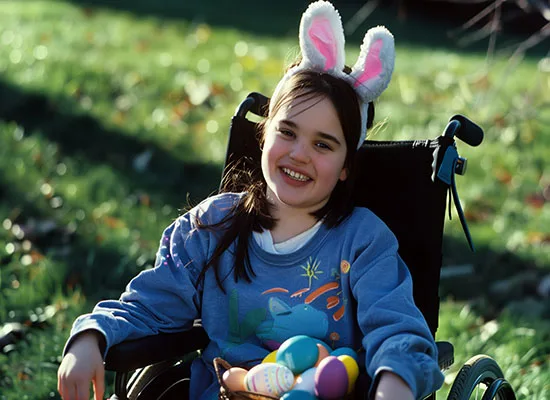
Enjoy inclusive egg hunts, time with the Easter Bunny and lots of family fun at sites across Illinois
Wondering where the Easter Bunny will hop next?
Check out our Special Events page to find sensory-friendly Easter Bunny visits and egg hunt options for individuals with disabilities of all ages.
The Bunny Cares program offers Easter Bunny visits in a calmer, quieter environment that supports visitors’ sensory, physical and developmental needs. Autism Speaks and Cherry Hill Programs have teamed up to provide these special Bunny Cares photo opportunities.
Bunny Cares events are scheduled at several malls in Illinois on Sunday, April 6.
Click on the locations below to learn more and book your free sensory bunny visit (be sure to search the event schedule for “Bunny Cares,” “Caring Bunny” or “Sensory Bunny” for each location):
Photos will be available to buy at each event. Reservations are limited. Visit the Bunny Cares website for more details and a complete list of sites.
There are more “eggs-cellent” opportunities to meet the Easter Bunny and hunt for eggs throughout Illinois.
If you’re located in the west and northwest suburbs, check out Kidlist for Easter egg hunts and more.
We’ve also highlighted a variety of egg hunts and bunny visits happening in communities across the state. These events include:
- Bunny Hop Breakfast for People with Disabilities and Their Families in Schaumburg on April 5 from 9 to 10:30 a.m.
- Sensory-Friendly Easter Bunny Event in Springfield on April 5 from 10 a.m. to 12 p.m.
- The Dr. Patchett Extra Special Eggstravaganza in Carterville on April 5 from 11 a.m. to 1 p.m.
- Inclusive “Easter Egg Hunt Miracle Mile” Event in Rockford on April 6 from 2 to 4 p.m.
- Sensory Egg Hunt for Children With Disabilities in Champaign on April 12 from 1 to 3:15 p.m.
Our Special Events page has more opportunities for finding colorful eggs, having fun and celebrating spring.
Many of the events are free. You can use the contact and registration information provided with each event listing to learn more.
Please note that the Division of Specialized Care for Children (DSCC) does not sponsor or organize these events. We are sharing the details to help families find inclusive events in their communities.
Inclusive Camps for All Ages Offer Fun, Friendships and New Adventures!

Check out our summer camp list to explore opportunities and find the right fit for your camper
Does your child want to make new friends? Develop new skills? Meet others with their condition or become more independent?
Head to our 2025 summer camp list. You’ll find accessible day, overnight and family camps across Illinois and beyond.
These programs welcome campers with a wide range of needs, abilities and many of our Core Program’s eligible medical conditions. The camps also cater to a wide range of interests, including:
- Learning to program and other computer skills
- Building independence and self-advocacy skills
- Exploring the great outdoors
- Cooking, art, drama and more
If you’re looking for the perfect camp opportunity, there are several ways to search on our website:
- Use the search box and filter option on our Events page to search for camps and other related keywords and locations
- View our 2025 summer camp list
- Use our Events Calendar view
Our list continues to grow, so check back often!
PLEASE NOTE: we share these opportunities for information purposes only. The Division of Specialized Care for Children (DSCC) does not manage or coordinate these camp opportunities or programs. If you have questions about a specific camp, please use the contact number or website we list for each program.
If you know of any summer camp opportunities we should add, please send us the details at dscc@uic.edu.
Here’s to a fantastic summer filled with smiles and new experiences!
Annual Illinois Statewide Transition Conference Maps Out Routes to Adulthood
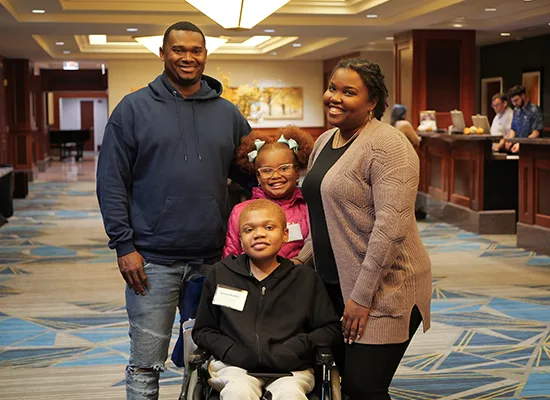
The annual Illinois Statewide Transition Conference provides valuable opportunities and resources to help youth and young adults with disabilities navigate the transition to adulthood.

Turning 18 is a major milestone. For Brenton Braxton and his family, they approached it with a mix of excitement and many questions about the future.
What benefits can Brenton qualify for as an adult? What should they know about guardianship and power of attorney?
Brenton has Duchenne muscular dystrophy, a genetic disorder that causes his muscles to weaken over time.
“When Brenton was first diagnosed when he was 7, these things that are being presented to us now – at that time, we had no idea that we’d be able to be at this place. So, that’s why my word I keep using is a sense of excitement because… Brenton’s still thriving,” his mom, Veneise, said.
Brenton is now a senior in high school with a strong interest in sports and a desire to go to college and “live life to the fullest.”
To help Brenton and his family prepare for what’s next, their Division of Specialized Care for Children (DSCC) Care Coordinator recommended they attend the Illinois Statewide Transition Conference.
The annual event provides valuable resources and information to help youth with disabilities and their families navigate the transition to adulthood.
“One of the major reasons why we wanted to attend this conference is that we wanted to get in the room with the resources. We wanted to get to the people, talk to the people, engage with the people that can say, ‘Hey, here’s what your child qualifies for. Hey, try this program for him, do this, go down this avenue,’” Veneise said.
“You just really want to have your feet grounded in knowing what’s getting ready to happen.”
The Braxtons were among nearly 450 people who attended the 19th Illinois Statewide Transition Conference, titled “Stepping Stones of Transition,” on Nov 7-8, 2024, at the Crowne Plaza Hotel and Convention Center in Springfield.
The transition conference brings together youth with disabilities, parents, caregivers, vocational professionals, healthcare professionals, educators and more.
Youth with disabilities and their families can network and find answers to common questions about the transition to adulthood, including:
- What happens after I leave high school?
- How do I sort through the maze of resources?
- What steps can I take now to prepare for upcoming changes?
- What skills are important for me to develop?
“Here we all are in one space.”

DSCC Home Care Family Outreach Associate Erica Stearns describes the annual conference as “a dream come true.”
Erica is the parent of two children enrolled with DSCC. Erica also has lived experience as an individual with disabilities.
“I was talking to another adult with disabilities before this interview, and it dawned on me, I didn’t grow up having this,” she said.
“To have an event where everyone is coming together for a similar purpose related to our children and their disabilities is incredibly meaningful, and it’s unique in that here we all are in one space.”
Erica highlighted the importance of ensuring youth and young adults have access to the information and resources they need as they transition to adulthood.

“It is abundantly clear that while we know that there are certain steps and certain paths that individuals with disabilities can take as they navigate their entry into adulthood, the information to prepare both their families and themselves for that is very challenging to find,” she said.
“I think most families feel empowered with knowledge. And I think that’s what this conference provides families is information, knowledge, tools and resources.”
DSCC helps sponsor the conference and serves on its steering committee. DSCC also provides financial support to help participant families attend the conference.
Claire Cook is DSCC’s Title V Transition Specialist and co-chair of the Transition Conference’s Steering Committee.
“Several families came back from last year,” said Claire. “We had about 20 or so individual families from DSCC, five of which were primarily Spanish speaking and several of our transition-age youth.”
“A lot of opportunities, a lot of information.”

Jani, 14, attended the conference with his mom, Aimee, and sister, Grace.
Jani has spinal muscular atrophy (SMA). He first enrolled with DSCC when he was diagnosed with SMA, close to 12 years ago.
Jani described the conference as a positive experience with valuable information. He and his family gained resources, discovered new opportunities and made connections.
“We had a very nice family that was sitting by us (at lunch), whose son had a similar disability. It was just nice to talk to them and hear their story,” Jani said.
When asked if he would recommend the conference to other young adults, he said, “You should definitely come because it has a lot of opportunities, a lot of information. It’s just good to come to understand what’s going to happen, what they want to do later in life.”
After high school, Jani plans to go to college and become a teacher.
“I want her to be strong, and I want her to be confident.”
TaLeah, 17, attended the conference with her mom, Tamara. TaLeah first enrolled with DSCC 15 years ago, when she was diagnosed with hearing loss.
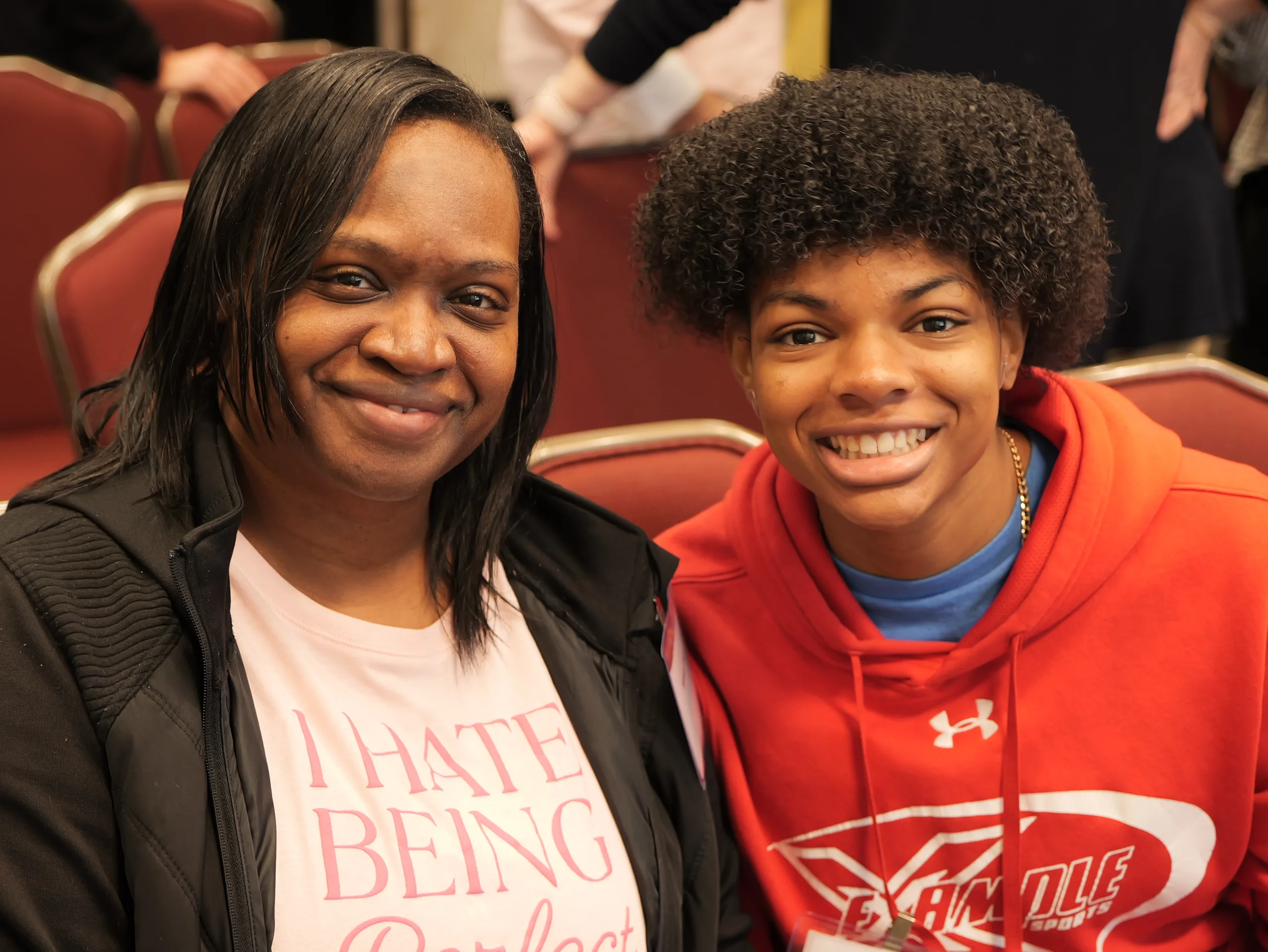
She is an accomplished basketball player who plans to go to college, play basketball and be successful.
“I want her to be strong, and I want her to be confident,” said Tamara.
“I want her to continue to advocate for herself and others. And I think she’s doing a good job thus far.”
Tamara said she is trying to give her daughter the best tools and equip her the best way she knows how.
“All this information is very helpful and hopefully it’ll help build her up.”
Brenton Braxton said the resources and knowledge his family gained at the conference will help him achieve his goals.
“I think some things from here that I learned is that not only I’ll still have my independence, but I can also use my parents to help me in my journey and to living it to the fullest and doing all the things I want to do,” he said.
On turning 18, he said, “It’s a big step, but I feel like with the support from my family and people around me, it’ll be good.”
Save the Date for the 2025 Transition Conference
The 2025 Illinois Statewide Transition Conference will take place Oct. 30-31 at the Crowne Plaza Hotel and Convention Center in Springfield.
To learn more about how to support youth with special healthcare needs during the transition to adulthood, contact DSCC at (800) 322-3722 or dscc@uic.edu.
For more information about the Transition Conference, visit www.illinoistransitionconference.org/.
Check out our Facebook page to see a photo album with more photos from the 2024 Transition Conference.
Free Family Webinar Series Focuses on Medicaid Waivers
Learn more about the MFTD, DRS and DDD Medicaid waivers and how they can help your family
Our annual Health Insurance Education Series returns in March to help families understand important health insurance topics.
In response to family feedback, our 2025 series will explain Medicaid Home and Community-Based Services Waiver Programs for Illinois.
The webinars are open to Division of Specialized Care for Children (DSCC) participants, their family members and anyone interested in these topics.
These free virtual trainings will feature DSCC team members and other presenters covering a different waiver each month:
- Medically Fragile and Technology Dependent (MFTD) Medicaid Waiver, March 11 at 6 p.m.
- The March presentation will focus on the Medically Fragile and Technology Dependent Waiver for children and adults. Presenters from DSCC will explain how to apply, who is eligible, what benefits are available, and how to use the benefits.
- See the MFTD Medicaid Waiver flyer
- Register on Zoom for MFTD Medicaid Waiver
- Division of Rehabilitation Services (DRS) Medicaid Waivers, April 8 at 6 p.m.
- The April presentation will focus on the different waivers available for children and young adults through the Division of Rehabilitation Services (DRS). Presenters from DRS will explain how to apply, who is eligible, what benefits are available, and how to use the benefits.
- See the DRS Medicaid Waivers flyer
- Register on Zoom for DRS Medicaid Waivers
- Division of Developmental Disabilities (DDD) Medicaid Waivers, May 13 at 6 p.m.
- The May presentation will focus on the different waivers for children and young adults available through the Division of Developmental Disabilities (DDD). Presenters from DDD will explain how to apply, who is eligible, what benefits are available, and how to use the benefits.
- See the DDD Medicaid Waivers flyer
- Register on Zoom for DDD Medicaid Waivers
- La Excepción de Medicaid para personas médicamente frágiles y dependientes de la tecnología (MFTD), 11 de marzo, a las 6 p.m.
- La presentación de marzo se centrará en la excepción para personas médicamente frágiles y dependientes de la tecnología para niños y adultos. Los presentadores de la División de Atención Especializada para Niños (DSCC) le explicarán cómo presentar la solicitud, quién es elegible, qué beneficios están disponibles y cómo utilizarlos.
- Consulte el folleto de Beneficios de MFTD para obtener más detalles.
- Registrarse para MFTD en Zoom.
- Excepciones de Medicaid de la División de Servicios de Rehabilitación (DRS), 8 de abril a las 6 p.m.
- La presentación de abril se centrará en las diferentes excepciones disponibles para niños y adultos jóvenes a través de la División de Servicios de Rehabilitación (DRS). Los presentadores de DRS explicarán cómo presentar la solicitud, quién es elegible, qué beneficios están disponibles y cómo utilizarlos.
- Consulte el folleto de Excepciones de Medicaid de la DRS para obtener más detalles.
- Registrarse para Excepciones de Medicaid de la DRS en Zoom.
- Excepciones de Medicaid de la División de Discapacidades del Desarrollo (DDD), 13 de mayo a las 6 p.m.
- La presentación de mayo se centrará en las diferentes excepciones para niños y adultos jóvenes disponibles a través de la División de Discapacidades del Desarrollo (DDD). Los presentadores de DDD explicarán cómo presentar la solicitud, quién es elegible, qué beneficios están disponibles y cómo utilizarlos.
- Consulte el folleto de Excepciones de Medicaid de la DDD para obtener más detalles.
- Registrarse para Excepciones de Medicaid de la DDD en Zoom.
You can also:
- Download a flyer with all Health Insurance Education Series topics and registration links. (The flyer is also available in Spanish.)
- See details about each series session on our Events page.
- Watch the session recordings and access related materials anytime on our Family Education Webinars page.
Our Health Insurance Education Series began in response to questions and suggestions from our Family Advisory Council.
If you have questions about these webinars before or after a session, please email dscc@uic.edu or call (800) 322-3722.
DSCC Families, We Want Your Feedback!
Our annual family survey is an easy way to share your input and help improve our services.
Attention participant families, be sure to watch your mail or email!
On Feb. 10, all Division of Specialized Care for Children (DSCC) participants will receive our annual family survey.
This survey asks how well our team members support your family and meet your needs. It also asks about:
- Your contact preferences
- How and when you’d like to meet with our team
- How well our staff communicates with you
You will receive this survey by email or mail, based on your preferences. If you respond, you could win one of five $50 Amazon gift cards.*
Your responses will help us strengthen your services. They also guide updates to our DSCC policies and procedures that affect your family.
Our surveys are optional, but we strongly encourage you to share your experiences. We want to ensure we’re doing all we can to help you meet your family’s needs and achieve your goals.
* Please note: Foreign national nonresident aliens are not eligible for the gift card participation prize.
How Your Feedback Makes a Difference

Your ideas and feedback help improve our services to families like yours. We used family input from last year’s survey to:
- Train our care coordination teams to better understand the family perspective and tailor services to your unique needs and wants.
- Educate families about the benefits of our DSCC Family Portal to easily communicate and share information with your care coordination team.
- Launch NurseNet, a new online tool to help families connect with available in-home nurses.
- Offer free webinars on important health insurance topics affecting families.
- Improve our language access to better support our families’ diverse backgrounds.
- Reorganize our Chicago offices to better serve the Chicago community.
Please be on the lookout for our annual survey on Feb. 10.
If you have questions or need more information, please contact your Care Coordinator.
We appreciate your partnership and look forward to hearing from you!
Be a Part of Illinois Miss Amazing

Miss Amazing is a national nonprofit program that encourages girls and women with disabilities to consider their goals, challenge themselves and take pride in who they are.
The Illinois Miss Amazing experience brings together a diverse group of participants to build friendships, build self-confidence and practice key self-advocacy skills in a fun environment.
The 2025 Illinois Miss Amazing program is accepting applications for participants through Jan. 25.
The program is also accepting application for volunteers who want to help and share in the experience.
The 2025 Illinois Miss Amazing Amplify event is on Feb. 22 at Center Stage Theater in Naperville.
Participation is open to girls and women ages 5 and older who have:
- An Individualized Education Program (IEP) or Individualized Program Plan (IPP)
- A 504 Plan
- Supplemental Security Income (SSI)
- A physician’s records proving disability
Amplify event activities will include:
- Show rehearsal
- Interviewing
- Passion presentation
- Hair, makeup and more
Are you ready to share your passion and shine?
Illinois Miss Amazing will accept applications until Jan. 25 or when all spots fill up.
Volunteers with and without disabilities can also lend a hand on and off the stage. Visit the Illinois Miss Amazing website to apply as a volunteer or learn more about volunteer options.
You can also read about our former participant, Izzy Gonzalez, an Illinois Miss Amazing alum pursuing a career in theater.
Share Your Feedback to Allow CNAs as Paid Family Caregivers
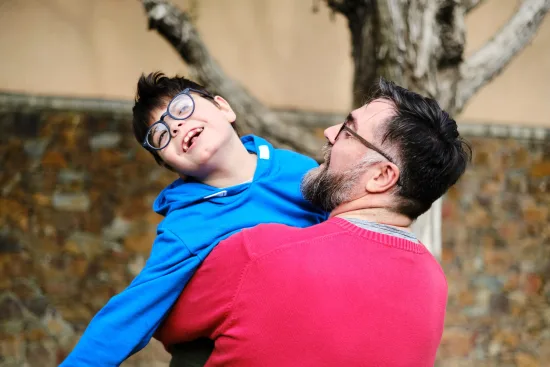
Families have until Jan. 30, 2025, to share their input on a state plan amendment allowing CNAs to become paid family caregivers.
Families can now share their feedback to allow more parents/legally responsible adults (LRAs) to become paid caregivers for their children at home.
The public comment period is currently open for a state plan amendment allowing parents/LRAs to become paid caregivers if they are a certified nursing assistant (CNA) and employed by a nursing agency.
Currently, parents/LRAs are paid for providing skilled nursing services to their children if they hold an active registered nurse (RN) or licensed practical nurse (LPN) license. This rule applies to parents/LRAs of all children approved for Home Care Program services, regardless of the child’s age.
Allowing parents and caregivers who are CNAs to become paid caregivers is an important step in strengthening support for families of individuals who need in-home shift nursing.
This change requires an amendment to the Medicaid Home and Community-Based Services Waiver for Those Who Are Medically Fragile, Technology Dependent (MFTD waiver). It also requires the creation of a new state plan amendment. Both approvals must be in place to allow for this change.
The public comment period for the new state plan amendment is now open until Jan. 30. You can read the public comment notice for the state plan amendment on the Illinois Department of Healthcare and Family Services (HFS) website.
Here is how you can review the amendment and share your feedback.
Review the Amendment
- Visit the HFS website to download and/or print a copy of the proposed state plan amendment.
- Email HFS.BPPC@illinois.gov to request a digital copy of the proposed state plan amendment.
- Review a hard copy of the proposed state plan amendment at HFS’ offices at:
- 201 South Grand Ave. E.,
Springfield, IL 62763 - 401 S. Clinton
Chicago, IL 60607
- 201 South Grand Ave. E.,
Springfield, IL 62763 - 401 S. Clinton
Chicago, IL 60607
- 201 South Grand Ave. E.,
Share Your Feedback
HFS is accepting public input on the proposed state plan amendment through Jan. 30, 2025.
You can share your feedback in two ways:
- Email your input to HFS.BPPC@illinois.gov.
- Mail your written input to the Illinois Department of Healthcare and Family Services, Attention: Bureau of Program and Policy Coordination, 201 South Grand Ave. E., 2nd floor, Springfield, IL 62763
This public comment process is one of the best ways you can make your voice heard.
Next Steps
In addition to the new state plan amendment, we have worked closely with HFS to incorporate this new rule into the MFTD waiver. This waiver amendment is currently under federal review for approval.
There is currently no set timeline for the state plan amendment and the MFTD waiver amendment to be approved.
Once approved, we will notify our Division of Specialized Care for Children (DSCC) participant families as quickly as possible.
If you have any questions, please contact your DSCC Care Coordinator at (800) 322-3722.
Sensory-Friendly and Inclusive Holiday Events for All Ages

Experience the magic of the season with Santa visits, light displays and other fun events happening throughout Illinois.
The holiday season is a time for joy, connection and celebration. For individuals with sensory sensitivities and other disabilities, traditional festivities can sometimes feel overwhelming.
We’ve gathered a list of inclusive and sensory-friendly holiday events happening throughout Illinois to help families celebrate the season.
There are light displays, sensitive Santa opportunities, parades and more going on throughout Illinois.
Our Special Events page includes a roundup of opportunities designed specifically for youth with disabilities and special healthcare needs.
We hope this collection of events will help spark ideas to create your own holiday magic:
- The Secret Sleigh Project coordinates volunteers to provide in-home Santa visits to children who are medically fragile nationwide. See our Secret Sleigh event listing for more details on how to request a visit.
- Autism Speaks and Cherry Hill Programs will provide free sensory-friendly Santa experiences at multiple shopping centers in Illinois on Dec. 8. You must sign up to attend. Photo packages will be available to buy. Visit the Santa Cares website for a complete list of Santa’s stops. Be sure to select “Santa Cares”, “Caring Santa” or “Sensitive Santa” when checking your location. (Note some event dates and times may vary. Please check your location to confirm your date and time.)
- The National Federation of the Blind is offering letters from Santa and winter celebration letters in Braille to children who are blind or have low vision. The program is for children 10 years old and younger. Please complete the letter request form by Dec. 16. Letters are available in English or Spanish. If you have any questions, call (410) 659-9314, ext. 2236, or email education@nfb.org.
- Enjoy a movie on the big screen with the lights up, lower sound and the freedom to get up, dance, walk, shout or sing. Visit the following sites to find more details and a theater near you:
- For families in the Chicago area, Chicago Parent magazine has a roundup of sensory-friendly Chicagoland events as a list of free holiday activities for Chicagoland families. Activities include:
- In central Illinois, enjoy time with Santa at the sensory-friendly “Meet and Greet with Santa” in Springfield or the “Sensory Hour Sweets with Santa” at the Allerton Mansion in Monticello. The Illinois Times family event calendar and Chambanamoms.com website also provide lists of events, parades, light displays and more in and around the Springfield and Champaign-Urbana areas.
- Southern Illinois residents can find many fun seasonal activities on SI Families’ event calendar. It’s packed with ideas including the:
- St. Louis events include Breakfast with Signing Santa and Milk & Cookies with Santa in St. Louis – Chesterfield.
- The animals at zoos throughout Illinois are celebrating the season, too! Check out Sensory Night at St. Louis Zoo Wild Lights, ZooLights at Lincoln Park Zoo or contact your local zoo to find out what’s happening and when.
Be sure to check our Special Events page often as we add more holiday activities to the list. If you know of a good sensory-friendly event to share, please email us at dscc@uic.edu.
Happy Holidays!
Please note, the University of Illinois Chicago’s Division of Specialized Care for Children (DSCC) is not involved in the organizing or scheduling of these holiday events. If you have questions about a specific event, please contact the event sponsor or organizer.
Share Your Input at Our Nov. 14 Family Advisory Council Open Forum
All Illinois families of children with special healthcare needs are welcome to share their feedback and experiences at this virtual forum.
Join us for an opportunity to connect with other families and share your feedback on topics that matter to you.
Our next Family Advisory Council (FAC) open forum is on Nov. 14 from 9 to 11 a.m.
This free virtual meeting is for all Illinois families of children with special healthcare needs. You do not have to be a Division of Specialized Care for Children (DSCC) participant to attend.
Visit our open forum event page for the link to join the meeting. Please note that live Spanish translation will be available during the open forum.
The FAC guides our efforts to strengthen teamwork, improve communication and empower families to have a voice in their children’s care. The council also connects families to resources and other families who are on a similar journey.
Our FAC has played an important role in developing:
- Our new DSCC Family Portal to help families more easily communicate and share information with their DSCC care coordination team
- New “All About Me” Page templates to help providers, care coordination teams, schools and other caregivers understand the likes, strengths and needs of each child beyond their medical diagnosis
- A free, virtual Health Insurance Education Series to help families navigate the insurance maze and better understand their coverage and benefits
- Improvements to our family survey process, including reducing the number of surveys that families receive
- Updates to our online Resource Directory and more
You can find the minutes from past meetings and more details on our website’s Family Advisory Council page.
If you have questions or would like more details on how to participate in the FAC, please email dsccfac@uic.edu.
We hope to see you on Nov. 14!