


Honor National Family Caregivers Month by Caring for Yourself
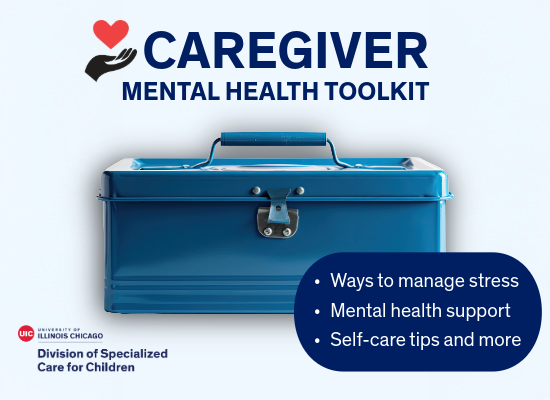
We’ve developed resources to help you support your mental health, reduce stress and connect with others who understand.
November is National Family Caregivers Month, a time to recognize and celebrate the incredible dedication of families caring for children and youth with special healthcare needs.
At the Division of Specialized Care for Children (DSCC), we know that caregiving can be both a rewarding and challenging journey.
As you care for others, it’s just as important to take care of your own mental health.
Find Support in Our Caregiver Mental Health Toolkit
Our Caregiver Mental Health Toolkit can help you find the support and strategies you need to recharge and stay well.
This online resource offers practical tips, self-care strategies and mental health resources to help you navigate the unique demands of caregiving while prioritizing your own health and well-being.
The Caregiver Mental Health Toolkit includes:
- Stress management strategies and techniques to help you cope with tough times.
- Self-care tips and practical ways to nurture your own physical, emotional and mental health.
- Mental health support resources to connect you with professional help and support networks when needed.
- Apps, online tools, videos and podcasts you can access anytime.
We created this toolkit with input from our Family Advisory Council, which shared the importance of mental health support for caregivers like you.
Whether you’re a parent caring for a child, a family member supporting a loved one or anyone in a caregiving role, we encourage you to explore this free resource.
Connect With a Fellow Caregiver for Support
One of the most powerful supports you can have is a connection with another parent who truly understands.
We have a Home Care Family Outreach Associate on our team who understands the unique challenges of caring for a loved one with complex medical conditions firsthand.
Our Home Care Family Outreach Associate works to create a community for caregivers within DSCC and offer heartfelt support, connection and empowerment.
You can ask your DSCC care coordination team to refer you to the HCFOA. You can also email a request to speak with the HCFOA at DSCC-FamilySupport@uic.edu.
Learn more about Erica Stearns, our current HCFOA, on our Home Care Family Outreach page and in the short video below:
Take a Break with Caregiver Coloring Sheets
We’ve also designed four coloring pages to help caregivers relax and take time to relieve stress and practice mindfulness.
There are four designs available in both English and Spanish:
- Lighthouse (Lighthouse in Spanish)
- Sunflowers (Sunflowers in Spanish)
- Hot air balloons (Hot air balloons in Spanish)
- Gears and clock (Gears and clock in Spanish)
These printable pages are a simple way to pause, relax and focus on yourself.
More Mental Health Resources and Support
You can find more mental health resources in our online Resource Directory.
Be sure to also follow our DSCC Facebook page and Instagram page for helpful reminders and tips throughout the rest of the month.
Your DSCC care coordination team is also here to support you. They can listen, help identify your needs and find available services and resources.
As the heart of your child’s care team, we celebrate you this month and always!
Resources to Become a Certified Nursing Assistant
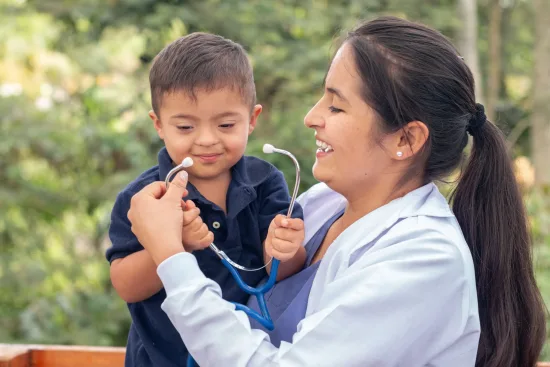
We developed a tip sheet to help guide parents and caregivers through the steps to become a CNA.
We continue to wait for approval to allow parents/legally responsible adults (LRAs) to become paid caregivers if they are a certified nursing assistant (CNA) and employed by a nursing agency.
We understand that our participant families are eager for this change to take effect. Allowing parents and caregivers who are CNAs to become paid caregivers is an important step in strengthening support for families of individuals who need in-home shift nursing.
To help families prepare as we await approval, we’ve put together a Certified Nursing Assistant Resources Tip Sheet.
This tip sheet aims to guide parents and caregivers through the steps to become a CNA. It links to several websites for your convenience and provides general guidelines.
You can also find the CNA Resources Tip Sheet on our Home Care Nursing Information for Families page.
Our Family Advisory Council reviewed this tip sheet to make sure it’s as helpful for families as possible.
Please remember that currently, parents/LRAs can only be paid for providing skilled nursing services to their children if they hold an active registered nurse (RN) or licensed practical nurse (LPN) license. This rule applies to parents/LRAs of all children approved for Home Care Program services, regardless of the child’s age.
The plan to allow CNAs as paid family caregivers requires an amendment to the Medicaid Home and Community-Based Services Waiver for Those Who Are Medically Fragile, Technology Dependent (MFTD waiver). It also requires the creation of a new state plan amendment. Both approvals must be in place to allow for this change.
There is currently no set timeline for the state plan amendment and the MFTD waiver amendment to be approved.
Once approved, we will notify you as quickly as possible.
If you have any questions, please contact your DSCC Care Coordinator at (800) 322-3722.
In-Depth Training Opportunity in Chicago for Families and Caregivers of Children with Complex Medical Needs
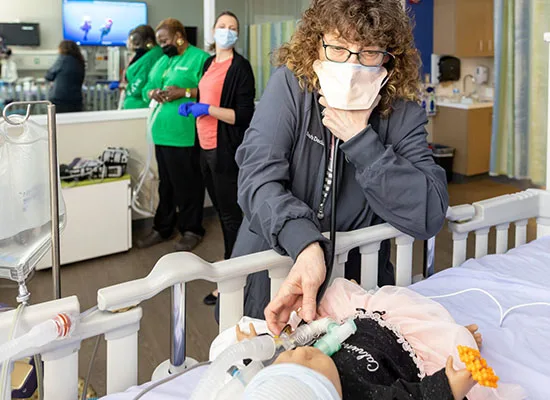
This free in-person training will take place July 24-25 at UIC’s Simulation and Integrative Learning Center in Chicago.
Registration is now open for a special in-person training program for the families and caregivers of children with complex medical needs.
This free two-day training will take place Wednesday, July 24, through Thursday, July 25, at the University of Illinois Chicago Simulation and Integrative Learning (SAIL) Center on the fifth floor at 1220 S. Wood St. in Chicago.
Families have expressed the need for more support for parents/caregivers of children with complex medical needs. We are excited to partner with Almost Home Kids to provide this valuable training opportunity. It will offer essential tools and knowledge to help you in your caregiving journey.
The training will be from 8 a.m. to 4:30 p.m. each day. The in-depth curriculum will include:
- Reducing the risk of infection
- Skin care
- Daily care of the child with a tracheostomy and ventilator
- Activity and movement
- Equipment and alarms
- Gastrostomy care and feeding
- Tracheostomy basics
- Respiratory assessment and interventions
- Ventilator training with hands-on practice
- Emergency preparedness
- Caregiver resiliency and well-being
- Simulation learning experience
You can also see the Caregiver Simulated Training flyer for more details.
Please sign up online to participate in the training. There is no cost to attend.
For more information, email connect@almosthomekids.org or contact Yolanda Rivera at yrivera@luriechildrens.org.
This training is part of our efforts to use federal funding from the American Rescue Plan Act to improve support and services for families of children with complex medical needs.
Almost Home Kids (AHK) provides a bridge from hospital to home through an innovative community-based care system for children with medical complexities. Its services include:
- Responding to the needs of families
- Training caregivers
- Advocating for accessibility and inclusion
- Educating healthcare professionals
Almost Home Kids has locations in Chicago, Naperville and Peoria.