


Star Raft Project Builds Support for Individuals With Disabilities

Project to help people with disabilities and their families build a circle of support, connection and safety
The Arc of Illinois and the Illinois Council on Developmental Disabilities have launched a project to help individuals with disabilities and their families/caregivers through the COVID-19 pandemic and beyond.
The Illinois Start Raft Project brings together the tools needed to build a circle of support, connection and increased safety for yourself, a family member or someone for whom you advocate.
The project’s presenter and coach is David Wetherow, founder of the Star Raft Project.
The Star Raft method aims to create lifelong support networks that are person-centered, family-friendly and strengthened by relationships in the larger community.
Wetherow is hosting a six-month set of free weekly Zoom meetings in which participants will find:
- Tools, materials and personal coaching for building a circle of companionship, connection and opportunity for yourself, for a family member or for someone you support.
- An enjoyable method for sharing the work that will wake up everyone’s contribution.
- A ‘navigation chart’ and a set of printable cards that can help you use great strategies and host great meetings.
- Free Zoom accounts and coaching so you and your loved ones can stay connected in the time of social isolation and physical distancing.
- Six months of personal coaching and support for you and your circle.
The best way to learn about the Star Raft method and take your first steps will be to attend one of the introductory Zoom webinars.
Two introductory webinars will be held every Monday, one at 10 a.m. and one at 7 p.m., through February. The morning and afternoon webinar are identical, so you can choose the one that fits your schedule.
For more information about the project and to register for an introductory webinar, click on the Illinois Star Raft Project newsletter.
Virtual Summer Camp Opportunities

Programs for all ages, abilities and needs
Summer 2020 is anything but typical due to the COVID-19 pandemic.
Though many summer camps remain closed for in-person activities, some are offering virtual opportunities to keep children and young adults of all abilities engaged and learning.
Our list of 2020 summer camp opportunities includes daily adventures, arts and crafts, writing workshops, videos and career development camps. You can also visit our events calendar to see the activities listed by date.
For more learning and educational resources for youth, visit the Childcare, Learning and Education Tools section of our COVID-19 Resource Directory.
Families can also download our COVID-19 Memory Book for children to complete. The memory book is also available in Spanish.
Resources to Discuss Racism and Traumatic Events with Children

The American Academy of Pediatrics provides helpful resources and tips for families to have these important conversations.
Racism is harmful to our communities.
The Division of Specialized Care for Children (DSCC) shares the University’s commitment to addressing the injustice of racism and promoting equity and inclusion for all.
Racism can create toxic stress in children, teens and families that negatively affects their health and development, according to the American Academy of Pediatrics (AAP).
During these stressful and tumultuous times, families may struggle with how to discuss the issues of race and discrimination with their children.
AAP and HealthyChildren.org, the official parenting website of the AAP, provide the following resources and tips to help your family determine what is age and developmentally appropriate for your child:
Program Provides Free, Healthy Meals for School Children

The Summer Food Service Program is open to Illinois children ages 18 and under to fill the summer nutritional gap.
Many Illinois families depend on their children’s schools to provide regular, nutritious meals throughout the school year. The financial strain of the COVID-19 pandemic makes the need for summer nutrition programs even greater.
The Summer Food Service Program (SFSP) provides healthy meals and snacks to children and teens ages 18 and younger at hundreds of sites across the state.
To find a meal site near you:
- Text “FoodIL” to 877-877
- Visit SummerMealsIllinois.org
- Call (800) 359-2163
The Illinois State Board of Education (ISBE) runs the program, which is funded by the U.S. Department of Agriculture (USDA).
ISBE says it is using waivers from the USDA to allow meals to be served in safe, socially distanced ways, including:
- Curbside pickup
- Home delivery
- Provision of meals for multiple days of the week at one time
Parents and/or guardians will also be able to pick up meals and bring them home to their children.
“COVID-19 has turned many families’ lives upside down. Illinois’ summer meals programs help to ensure that one thing families do not have to worry about is where their children will get their next meal,” said State Superintendent of Education Dr. Carmen I. Ayala.
To learn more about this year’s program, visit the Illinois State Board of Education website.
Free Virtual Speech Therapy Sessions Available

UIUC’s Speech-Language Pathology and Audiology Clinic is providing free tele-practice appointments this summer for individuals and groups.
Do you or your child need speech-language pathology interventions but can’t see your clinician due to the COVID-19 pandemic?
The University of Illinois at Urbana-Champaign Speech-Language Pathology and Audiology Clinic is offering free tele-practice appointments this summer for individuals and groups.
Illinois residents can receive therapy services from supervised graduate clinicians. These clinicians are under the supervision of licensed and nationally certified speech-language pathologists.
Sessions are available through Aug. 6.
Those interested should email SHSCLINIC@illinois.edu. The clinic will ask you to complete and submit an online survey.
Sign-ups will be on a first-come, first-served basis.
More information is available at https://ahs.illinois.edu/slp-clinic.
DSCC Family Spreads Easter Joy to Hospitalized Children

The Johnson family donated 160 Easter baskets for children at Central DuPage Hospital, surpassing their goal despite the coronavirus outbreak
Andrea Stambaugh vividly recalls the disappointment she felt when her son, Axel Johnson, was in the pediatric intensive care unit on Easter weekend 2018.
There would be no coloring eggs, Easter egg hunts, or other favorite family celebrations.
“I was feeling like a failure because I didn’t have an Easter basket beautifully wrapped and thoughtfully hidden here for Axel to see on Easter morning,” Andrea wrote on her Facebook page, “Axel’s Journey with CMV.” “Then, as the lights turned down in the hallway and it grew quiet, I heard a family in the hallway praying. Praying not for Easter baskets and a chance to color eggs, but for life.”
The moment immediately changed her perspective. Andrea vowed to offer love and support to such families who can’t be home making memories with their children.

For the last two years, the Johnsons have collected donations to fill Easter baskets for hospitalized children. Despite unexpected challenges from the coronavirus outbreak, the family surpassed this year’s goal and delivered 160 Easter baskets to Central DuPage Hospital in Winfield.
“We know the burden and the mom guilt that people feel when they can’t provide their kid a proper holiday. We know that that’s a lot of stress and a lot of burden and frankly, the families are dealing with a lot of other things if they’re in the hospital,” Andrea said. “They shouldn’t have to feel that pressure, so we’re here to make sure that’s relieved from them and that they can focus on healing for their child.”
Axel is 3 years old and a participant in the University of Illinois at Chicago’s Division of Specialized Care for Children program.
After his Easter hospitalization, Andrea researched information from other organizations who coordinate Easter basket donations. She put together a list of suggested items, including coloring books, puzzles, dolls and action figures. She then asked her page followers for donations.
The Johnsons hoped to collect enough items for 25 baskets for Easter 2019. Donations far exceeded this goal. A team of volunteers helped them put together a total of 125 baskets for children at multiple Chicago-area hospitals.
This year, the Johnsons aimed to donate 150 baskets. They set up an Amazon wish list for Easter basket items, and donations started to pour in. But challenges soon arose as the coronavirus outbreak escalated. For safety reasons, two hospitals could no longer accept donations for patients.
Central DuPage Hospital could accept the baskets if the Johnsons followed strict safety precautions.
“We have an immunocompromised child, so we know about the importance of keeping the children and the families safe during this time,” Andrea said.
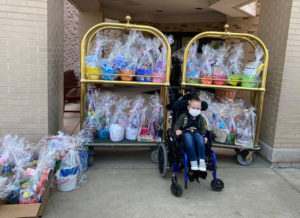
Every Easter basket item was purchased new and cleaned with bleach spray or a sanitizing wipe. Andrea and her partner, Adam Johnson, wore gloves and masks while sorting the items and wrapping the baskets with cellophane and personalized notes.
Due to the pandemic’s social distancing requirements, Andrea and Adam spent 16 hours packaging 160 baskets without their usual team of volunteers.
Last weekend, they delivered the baskets to Central DuPage Hospital in Winfield to be ready for patients on Easter Sunday.
“It makes our hearts really happy every year when we get to see the finished product and all of the kids that will be blessed this Easter,” Andrea said.
The family is also already planning to provide baskets to more hospitals next Easter.
For more information about their project and Axel’s condition, visit “Axel’s Journey with CMV” on Facebook.
Live Early Intervention Video Visits Now Available

Families may now receive EI services through video for their infants or toddlers with disabilities or delays.
The Illinois Department of Human Services (IDHS) is making Early Intervention (EI) services available through live video visits.
Families may now receive services through video for their infants or toddlers with disabilities or delays. EI services include help with movement, learning, interacting, behavior and self-help skills.
The virtual visits are in response to the coronavirus disease 2019 (COVID-19) pandemic.
“In light of the COVID-19 social distancing guidelines, Early Intervention face-to-face services were suspended on March 16. Since then, the IDHS Early Intervention team has been hard at work to secure an effective way to continue EI services, virtually,” according to an IDHS news release.
Families can work with their EI provider in real time with video and audio features over the internet.
IDHS says it is developing tip sheets to help families understand the process and get the most benefit out of their live video visits.
EI providers will contact families this week as they launch the live video visits.
Families can access EI services through the IDHS website.
Guidance and training for video visits is available on the EI Clearing House website.
Families can also find more information on using telehealth services and virtual therapy sessions in our COVID-19 resources and support list for families at https://dscc.uic.edu/browse-resources/covid-19-resources-and-supports-for-families/ .
COVID-19 Guidance for Medically Fragile Children

The Illinois Department of Public Health gives recommended guidance for preventing the spread of COVID-19 in medically fragile children.
The Illinois Department of Public Health has provided guidance for how to prevent the spread of the coronavirus disease 2019 (COVID-19) in medically fragile children.
The guidance includes:
- Planning actions for the home healthcare agency during a disease pandemic
- Preventative actions for the introduction of respiratory germs into your home
- Preventative actions for the introduction of respiratory germs within your home
- Preventative actions for vulnerable populations
- Contingency planning
The guidance is available in our COVID-19 resource list and at this direct link to the guidance document.
2020 Census Matters for Children With Special Healthcare Needs
The count helps support key programs and services for children and families.
Every 10 years, the U.S. Census Bureau counts all people in the United States. This count determines how much federal money is available for services and programs for children, including those with special healthcare needs.
By filling out the 2020 census form, parents can help ensure their children have the resources they need.
In March, the government will send every household a letter in the mail. This letter has instructions on how to fill out the census form.
The form asks for a count of everyone living at the address as of April 1, 2020. The count should include babies, young children and children with special healthcare needs and disabilities.
During the 2010 census, nearly one million young children were not counted, according to the Association of Maternal and Child Health Programs (AMCHP).
If young children are not counted in the 2020 census, the following programs could lose funds:
- Medicaid
- Children’s Health Insurance Program
- Supplemental Nutrition Assistance Program (SNAP)
- Title I funding
- Individuals with Disabilities Education Act (IDEA) special education funding
- Head Start
- Childcare and Development Block Grants
States and communities also use census data to fund and develop programs and services for children and families.
All census responses are confidential. Your answers are not shared with anyone and are only used to count the number of people in the country.
AMCHP provides a 2020 census fact sheet for parents. (A Spanish fact sheet is also available.) It explains how the census works, how young children should be counted and confidentiality.
The U.S. Census Bureau also provides helpful resources for parents:
You can also watch the Census Bureau video below: