


Meet Our Medical Advisory Board Member Dr. Sarah Sobotka
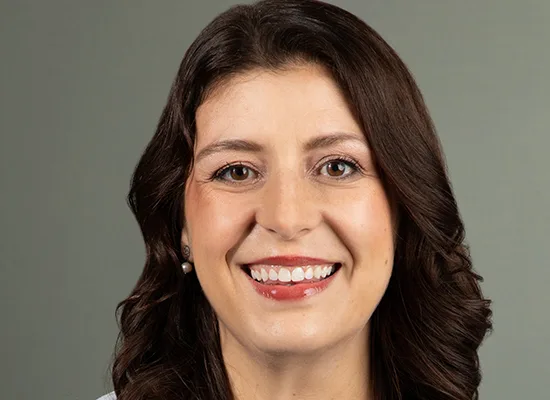
“My hope is that what I bring to DSCC… are the data points that help to drive advocacy and improvements in care.”
Dr. Sarah Sobotka first started working with the Division of Specialized Care for Children (DSCC) through her research to improve support for children with mechanical ventilators and their families.
“I have been working with DSCC as a critical partner in my research program since 2017,” she said, noting how DSCC helped recruit eligible families for her research studies.
“I am so fortunate to have had the enthusiastic support from DSCC because our missions are so aligned and from a research standpoint, it allows me to work with a state agency that lacks the bias of a single hospital center or a single institution… it is a more balanced sample, working with the entire state.”
Sobotka and DSCC share the same goal to better understand the needs of children with medical complexity and connect their families with the right services and support to achieve their best quality of life.
In 2020, DSCC’s leadership invited Sobotka to join our Medical Advisory Board as an expert medical provider.
Her research and expertise provide valuable perspectives on how to best allocate resources and improve systems of care for all Illinois children and youth with special healthcare needs.
An early focus on children with medical complexity leaving the hospital
Sobotka is an Associate Professor of Pediatrics, Section of Developmental and Behavioral Pediatrics, and Ambulatory Medical Director of Comer Developmental and Behavioral Pediatric Programs in the Department of Pediatrics at the University of Chicago.
She became interested in children with medical complexity while completing her residency.
“I did my pediatric residency, and then I elected to do a developmental and behavioral pediatric fellowship in order to focus on the diagnosis and support of children with disabilities and their families,” Sobotka said.
She quickly saw how long children with medical complexity and undiagnosed disability spent in the hospital.
“I recognized early on that an impediment to their flourishing and to their families’ functioning was the length of time they were in the hospital,” she said. “So, some of my early work focused on that process of discharge and the many components that have to get together in order for a child with medical complexity, particularly kids with ventilators, to leave the hospital.”
As part of Dr. Sobotka’s training, she took an additional year between her third and fourth year of medical school to complete a Master of Science for Clinical Professionals. This advanced degree gave her training in epidemiology and research.
Sobotka’s research focus has explored what happens after children with complex medical needs leave the hospital, what the home nursing landscape looks like and what individual families’ experiences and needs are.
One of Dr. Sobotka’s first research studies involved interviewing DSCC Care Coordinators, skilled private duty nurses, and parents of children in the Home Care Program who came home with a ventilator.
“I interviewed those parents a couple of times after going home, so I really started to understand the complexity of home care challenges and what that looked like for families,” she said.
This research project identified gaps in therapy services for these children, and Sobotka developed interventions to support their diverse disabilities. She also learned more about how DSCC Care Coordinators support families and what motivates and challenges professionals in this important role.
Improving the healthcare system’s efficiency
Over the last seven years, Sobotka has continued to partner with DSCC on multiple studies. Recent projects include:
- “Disparities in Home Nursing and Hospital Length of Stay for Children with Invasive Mechanical Ventilation: Identifying National Trends and Piloting a Parent-to-Parent Intervention”
- This study includes a parent-to-parent coaching pilot program for families. This pilot program is for families who have a child on a ventilator in the hospital and are awaiting home nursing so their child can be discharged home or have gone home and do not have enough home nursing support.
- “Let’s E.A.T! (Eating with Assistive Technology)”
- This study aims to help children with feeding tubes and tracheostomies (trachs) eat by mouth. It is for families who have a child under 3 years old with a feeding tube and trach.
You can read more about these studies on pages 35 and 36 of our FY 2024 Annual Report.
A major theme in Sobotka’s work is improving the healthcare system’s efficiency so that all children, especially those with medical complexity, spend more time in the least restrictive environment at home with their families.
“This ultimately has the greatest potential to improve their developmental trajectory, because although this is a population at high risk for complex disability, I still believe there are opportunities to mitigate the worst disability outcomes with the right interventions at the right times,” Sobotka said.
Sobotka says families’ experiences and feedback direct the course of her research.
As a Medical Advisory Board member, Sobotka enjoys the opportunity to collaborate with other members to advocate for parent caregivers. She also aims to keep families’ needs and priorities at the center of decisions and improvements in the healthcare system.
“My hope is that what I bring to DSCC and also to other investigators, clinicians, and families are the data points that help to drive advocacy and improvements in care,” she said.
Thank you, Dr. Sobotka, for your dedication to improving the lives of children with complex medical needs and their families!
Resources to Become a Certified Nursing Assistant

We developed a tip sheet to help guide parents and caregivers through the steps to become a CNA.
We continue to wait for approval to allow parents/legally responsible adults (LRAs) to become paid caregivers if they are a certified nursing assistant (CNA) and employed by a nursing agency.
We understand that our participant families are eager for this change to take effect. Allowing parents and caregivers who are CNAs to become paid caregivers is an important step in strengthening support for families of individuals who need in-home shift nursing.
To help families prepare as we await approval, we’ve put together a Certified Nursing Assistant Resources Tip Sheet.
This tip sheet aims to guide parents and caregivers through the steps to become a CNA. It links to several websites for your convenience and provides general guidelines.
You can also find the CNA Resources Tip Sheet on our Home Care Nursing Information for Families page.
Our Family Advisory Council reviewed this tip sheet to make sure it’s as helpful for families as possible.
Please remember that currently, parents/LRAs can only be paid for providing skilled nursing services to their children if they hold an active registered nurse (RN) or licensed practical nurse (LPN) license. This rule applies to parents/LRAs of all children approved for Home Care Program services, regardless of the child’s age.
The plan to allow CNAs as paid family caregivers requires an amendment to the Medicaid Home and Community-Based Services Waiver for Those Who Are Medically Fragile, Technology Dependent (MFTD waiver). It also requires the creation of a new state plan amendment. Both approvals must be in place to allow for this change.
There is currently no set timeline for the state plan amendment and the MFTD waiver amendment to be approved.
Once approved, we will notify you as quickly as possible.
If you have any questions, please contact your DSCC Care Coordinator at (800) 322-3722.
Free Family Webinar Series Focuses on Medicaid Waivers
Learn more about the MFTD, DRS and DDD Medicaid waivers and how they can help your family
Our annual Health Insurance Education Series returns in March to help families understand important health insurance topics.
In response to family feedback, our 2025 series will explain Medicaid Home and Community-Based Services Waiver Programs for Illinois.
The webinars are open to Division of Specialized Care for Children (DSCC) participants, their family members and anyone interested in these topics.
These free virtual trainings will feature DSCC team members and other presenters covering a different waiver each month:
- Medically Fragile and Technology Dependent (MFTD) Medicaid Waiver, March 11 at 6 p.m.
- The March presentation will focus on the Medically Fragile and Technology Dependent Waiver for children and adults. Presenters from DSCC will explain how to apply, who is eligible, what benefits are available, and how to use the benefits.
- See the MFTD Medicaid Waiver flyer
- Register on Zoom for MFTD Medicaid Waiver
- Division of Rehabilitation Services (DRS) Medicaid Waivers, April 8 at 6 p.m.
- The April presentation will focus on the different waivers available for children and young adults through the Division of Rehabilitation Services (DRS). Presenters from DRS will explain how to apply, who is eligible, what benefits are available, and how to use the benefits.
- See the DRS Medicaid Waivers flyer
- Register on Zoom for DRS Medicaid Waivers
- Division of Developmental Disabilities (DDD) Medicaid Waivers, May 13 at 6 p.m.
- The May presentation will focus on the different waivers for children and young adults available through the Division of Developmental Disabilities (DDD). Presenters from DDD will explain how to apply, who is eligible, what benefits are available, and how to use the benefits.
- See the DDD Medicaid Waivers flyer
- Register on Zoom for DDD Medicaid Waivers
- La Excepción de Medicaid para personas médicamente frágiles y dependientes de la tecnología (MFTD), 11 de marzo, a las 6 p.m.
- La presentación de marzo se centrará en la excepción para personas médicamente frágiles y dependientes de la tecnología para niños y adultos. Los presentadores de la División de Atención Especializada para Niños (DSCC) le explicarán cómo presentar la solicitud, quién es elegible, qué beneficios están disponibles y cómo utilizarlos.
- Consulte el folleto de Beneficios de MFTD para obtener más detalles.
- Registrarse para MFTD en Zoom.
- Excepciones de Medicaid de la División de Servicios de Rehabilitación (DRS), 8 de abril a las 6 p.m.
- La presentación de abril se centrará en las diferentes excepciones disponibles para niños y adultos jóvenes a través de la División de Servicios de Rehabilitación (DRS). Los presentadores de DRS explicarán cómo presentar la solicitud, quién es elegible, qué beneficios están disponibles y cómo utilizarlos.
- Consulte el folleto de Excepciones de Medicaid de la DRS para obtener más detalles.
- Registrarse para Excepciones de Medicaid de la DRS en Zoom.
- Excepciones de Medicaid de la División de Discapacidades del Desarrollo (DDD), 13 de mayo a las 6 p.m.
- La presentación de mayo se centrará en las diferentes excepciones para niños y adultos jóvenes disponibles a través de la División de Discapacidades del Desarrollo (DDD). Los presentadores de DDD explicarán cómo presentar la solicitud, quién es elegible, qué beneficios están disponibles y cómo utilizarlos.
- Consulte el folleto de Excepciones de Medicaid de la DDD para obtener más detalles.
- Registrarse para Excepciones de Medicaid de la DDD en Zoom.
You can also:
- Download a flyer with all Health Insurance Education Series topics and registration links. (The flyer is also available in Spanish.)
- See details about each series session on our Events page.
- Watch the session recordings and access related materials anytime on our Family Education Webinars page.
Our Health Insurance Education Series began in response to questions and suggestions from our Family Advisory Council.
If you have questions about these webinars before or after a session, please email dscc@uic.edu or call (800) 322-3722.
DSCC Families, We Want Your Feedback!
Our annual family survey is an easy way to share your input and help improve our services.
Attention participant families, be sure to watch your mail or email!
On Feb. 10, all Division of Specialized Care for Children (DSCC) participants will receive our annual family survey.
This survey asks how well our team members support your family and meet your needs. It also asks about:
- Your contact preferences
- How and when you’d like to meet with our team
- How well our staff communicates with you
You will receive this survey by email or mail, based on your preferences. If you respond, you could win one of five $50 Amazon gift cards.*
Your responses will help us strengthen your services. They also guide updates to our DSCC policies and procedures that affect your family.
Our surveys are optional, but we strongly encourage you to share your experiences. We want to ensure we’re doing all we can to help you meet your family’s needs and achieve your goals.
* Please note: Foreign national nonresident aliens are not eligible for the gift card participation prize.
How Your Feedback Makes a Difference

Your ideas and feedback help improve our services to families like yours. We used family input from last year’s survey to:
- Train our care coordination teams to better understand the family perspective and tailor services to your unique needs and wants.
- Educate families about the benefits of our DSCC Family Portal to easily communicate and share information with your care coordination team.
- Launch NurseNet, a new online tool to help families connect with available in-home nurses.
- Offer free webinars on important health insurance topics affecting families.
- Improve our language access to better support our families’ diverse backgrounds.
- Reorganize our Chicago offices to better serve the Chicago community.
Please be on the lookout for our annual survey on Feb. 10.
If you have questions or need more information, please contact your Care Coordinator.
We appreciate your partnership and look forward to hearing from you!
Share Your Feedback to Allow CNAs as Paid Family Caregivers

Families have until Jan. 30, 2025, to share their input on a state plan amendment allowing CNAs to become paid family caregivers.
Families can now share their feedback to allow more parents/legally responsible adults (LRAs) to become paid caregivers for their children at home.
The public comment period is currently open for a state plan amendment allowing parents/LRAs to become paid caregivers if they are a certified nursing assistant (CNA) and employed by a nursing agency.
Currently, parents/LRAs are paid for providing skilled nursing services to their children if they hold an active registered nurse (RN) or licensed practical nurse (LPN) license. This rule applies to parents/LRAs of all children approved for Home Care Program services, regardless of the child’s age.
Allowing parents and caregivers who are CNAs to become paid caregivers is an important step in strengthening support for families of individuals who need in-home shift nursing.
This change requires an amendment to the Medicaid Home and Community-Based Services Waiver for Those Who Are Medically Fragile, Technology Dependent (MFTD waiver). It also requires the creation of a new state plan amendment. Both approvals must be in place to allow for this change.
The public comment period for the new state plan amendment is now open until Jan. 30. You can read the public comment notice for the state plan amendment on the Illinois Department of Healthcare and Family Services (HFS) website.
Here is how you can review the amendment and share your feedback.
Review the Amendment
- Visit the HFS website to download and/or print a copy of the proposed state plan amendment.
- Email HFS.BPPC@illinois.gov to request a digital copy of the proposed state plan amendment.
- Review a hard copy of the proposed state plan amendment at HFS’ offices at:
- 201 South Grand Ave. E.,
Springfield, IL 62763 - 401 S. Clinton
Chicago, IL 60607
- 201 South Grand Ave. E.,
Springfield, IL 62763 - 401 S. Clinton
Chicago, IL 60607
- 201 South Grand Ave. E.,
Share Your Feedback
HFS is accepting public input on the proposed state plan amendment through Jan. 30, 2025.
You can share your feedback in two ways:
- Email your input to HFS.BPPC@illinois.gov.
- Mail your written input to the Illinois Department of Healthcare and Family Services, Attention: Bureau of Program and Policy Coordination, 201 South Grand Ave. E., 2nd floor, Springfield, IL 62763
This public comment process is one of the best ways you can make your voice heard.
Next Steps
In addition to the new state plan amendment, we have worked closely with HFS to incorporate this new rule into the MFTD waiver. This waiver amendment is currently under federal review for approval.
There is currently no set timeline for the state plan amendment and the MFTD waiver amendment to be approved.
Once approved, we will notify our Division of Specialized Care for Children (DSCC) participant families as quickly as possible.
If you have any questions, please contact your DSCC Care Coordinator at (800) 322-3722.