


Honor National Family Caregivers Month by Caring for Yourself
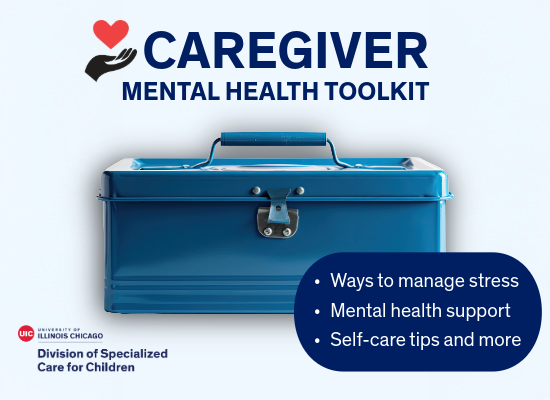
We’ve developed resources to help you support your mental health, reduce stress and connect with others who understand.
November is National Family Caregivers Month, a time to recognize and celebrate the incredible dedication of families caring for children and youth with special healthcare needs.
At the Division of Specialized Care for Children (DSCC), we know that caregiving can be both a rewarding and challenging journey.
As you care for others, it’s just as important to take care of your own mental health.
Find Support in Our Caregiver Mental Health Toolkit
Our Caregiver Mental Health Toolkit can help you find the support and strategies you need to recharge and stay well.
This online resource offers practical tips, self-care strategies and mental health resources to help you navigate the unique demands of caregiving while prioritizing your own health and well-being.
The Caregiver Mental Health Toolkit includes:
- Stress management strategies and techniques to help you cope with tough times.
- Self-care tips and practical ways to nurture your own physical, emotional and mental health.
- Mental health support resources to connect you with professional help and support networks when needed.
- Apps, online tools, videos and podcasts you can access anytime.
We created this toolkit with input from our Family Advisory Council, which shared the importance of mental health support for caregivers like you.
Whether you’re a parent caring for a child, a family member supporting a loved one or anyone in a caregiving role, we encourage you to explore this free resource.
Connect With a Fellow Caregiver for Support
One of the most powerful supports you can have is a connection with another parent who truly understands.
We have a Home Care Family Outreach Associate on our team who understands the unique challenges of caring for a loved one with complex medical conditions firsthand.
Our Home Care Family Outreach Associate works to create a community for caregivers within DSCC and offer heartfelt support, connection and empowerment.
You can ask your DSCC care coordination team to refer you to the HCFOA. You can also email a request to speak with the HCFOA at DSCC-FamilySupport@uic.edu.
Learn more about Erica Stearns, our current HCFOA, on our Home Care Family Outreach page and in the short video below:
Take a Break with Caregiver Coloring Sheets
We’ve also designed four coloring pages to help caregivers relax and take time to relieve stress and practice mindfulness.
There are four designs available in both English and Spanish:
- Lighthouse (Lighthouse in Spanish)
- Sunflowers (Sunflowers in Spanish)
- Hot air balloons (Hot air balloons in Spanish)
- Gears and clock (Gears and clock in Spanish)
These printable pages are a simple way to pause, relax and focus on yourself.
More Mental Health Resources and Support
You can find more mental health resources in our online Resource Directory.
Be sure to also follow our DSCC Facebook page and Instagram page for helpful reminders and tips throughout the rest of the month.
Your DSCC care coordination team is also here to support you. They can listen, help identify your needs and find available services and resources.
As the heart of your child’s care team, we celebrate you this month and always!
Research Study Seeks Families to Help Improve Home Health Care for Children
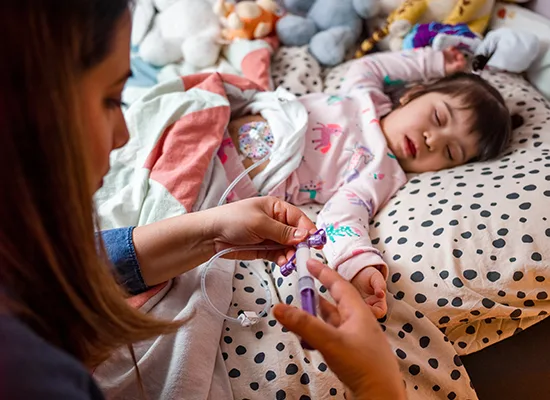
“SafeCare@Home4Kids” aims to understand and prevent safety issues at home for children with medical complexity
A research study is looking for families to help improve home health care for children with complex medical needs.
The study is called “The SafeCare@Home4Kids Learning Lab: Designing Safer Healthcare at Home for Children.” It wants to learn from parents of children with medical complexity about what it is like to care for your children at home, including giving your children complex medication and using your children’s devices. The study aims to find ways to help prevent safety problems with this complex caregiving at home.
Dr. Carolyn Foster of Ann and Robert H. Lurie Children’s Hospital of Chicago is leading the research team. Foster is also a member of the Division of Specialized Care for Children’s (DSCC) Medical Advisory Board.
By sharing your experiences, you can help “SafeCare@Home4Kids” find ways to better support and help parents while reducing problems and challenges at home.
What does the study involve?
Participation in the study will take about one week. For seven days, you will send photos or text-based messages about your experience with your child’s medication-related activities and devices at home. Please note, if you do not have a device, the study researchers will loan you one.
After the week is over, you will meet with research team members to talk about your messages. You will also participate in a “critical decision methods” interview about how you:
- Identify problems with your child’s medication or device
- Communicate the problem
- How you have problem-solved these issues in the past
The research team will keep your answers confidential. If you complete all study steps, you can receive up to $195 by virtual gift card.
How do I participate?
You can enroll in the “SafeCare@Home4Kids” study if you:
- Speak English or Spanish
- Have a child who is 17 years old or younger with a disabling complex chronic condition who uses an implanted medical device to receive medication at home (such as a gastrostomy tube)
Please email fosterlab@luriechildrens.org or call (312) 227-2510 to enroll or ask questions.
For more details about the “SafeCare@Home4Kids” study and DSCC’s involvement, please visit https://dscc.uic.edu/dscc-partners-in-research-study-to-improve-home-health-care-for-children/.
You can also see the study flyer for more information.